



Case studies

Martin, Adult learner with severe dyslexia
I’m fifty years-old and I’m a hairstylist but I can say that I’ve endured a lifetime of struggles because of my dyslexia. It’s so severe that if it weren’t for my computer, I would still be completely illiterate. I was actually looking for different tools to use on my iPad when I discovered Touch-type Read and Spell. I can already say that TTRS is fantastic. I enjoy it and I do it every day. I wish they had had a multi-sensory program like this when I was at school.

Alexis, Adult learner with mild dyslexia
I work at a children’s book publisher and I do most of my writing on the computer. Listening to the words in TTRS really helps me. I can hear and see the word, so it’s easier for me to pinpoint whatever little thing I’m doing in my mind that’s not working. For example, I tend to struggle with vowel sounds and I’m always one letter off. TTRS is great because it helps me see these issues - it makes it really clear when I miss a letter. Plus, I like it and I actually look forward to doing it!
Gemma, Parent of a child with dyspraxia
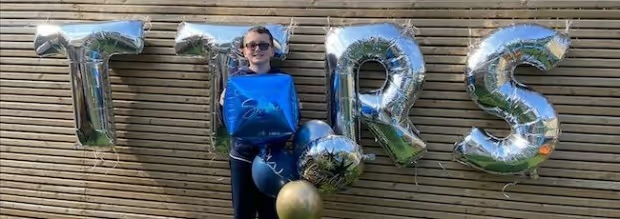
My son started using the Touch-type Read and Spell course with a tutor about two years ago. When he finished this April, we had a little celebration for him out in the garden. He felt such a sense of achievement from having completed TTRS and I couldn’t be prouder of him! Shane now brings his laptop to school and uses it when there are writing assignments. In addition to his typing skills, we’ve seen an impact on his spelling as well.
Lisa, Parent of a 7th grader with dyslexia, dysgraphia, and apraxia
A deciding factor for me was the multi-sensory teaching aspect of TTRS. These kinds of methods are exactly what students with dyslexia and dysgraphia need. TTRS checks so many boxes: word lists, academic vocabulary by subjects, sight words, word endings, homophones. We also love being able to customize the visual display of the program. My son does about three modules each day -- they are quick and painless. And the best part is he is learning!

Heather, Parent of an 11-year-old with autism
I have an 11-year-old autistic son who has high anxiety and I was looking for a program that would be functional, but also have a strong academic skill base. TTRS provides the auditory input my son really needs. We use it to help with reading, as well as typing and spelling. In learning to read, seeing the words, hearing the sounds and using his hands at the same time has been a complete game changer for my son.

Emma, Parent of a child with special needs
We started using the Touch-type Read and Spell program because my daughter has quite a high number of special needs. This program is teaching her to see the letter patterns in real words. We sit down and there’s repetition in a module. My daughter types similarly shaped words with similar endings. The way her brain works, she looks at a word and can read it, but she can’t copy the spelling of it. This program is teaching her to see the letter patterns.
Vivian, Homeschooler of a child with dyslexia
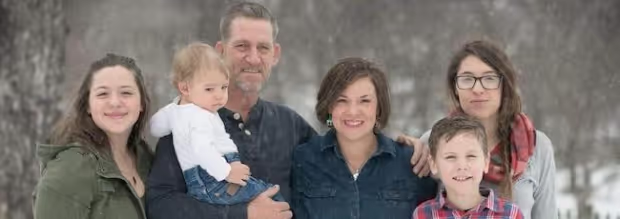
I have a ten year-old son who has dyslexia. My daughter is in eighth grade and she also uses Touch-type Read and Spell. She is not dyslexic but the program helps with her keyboarding practice and spelling. We homeschool and work on a small budget - almost everything we use is free - but TTRS is a program we happily pay for. My children look forward to their typing lessons.

Director of Curriculum at an independent-study charter school
Our independent-study online charter school supports students in grades TK-12. It’s important to us that we provide access to diverse educational models – and one of the enrichment options we have is Touch-type Read and Spell (TTRS). If a student is struggling with letters or sounds, their teacher will ask them to take TTRS for extra literacy support. With the way everything is moving technologically, typing is an important skill to have, as many of our students use typing for other coursework.

Annette, Adult learner returning to school
I’ve always known I had dyslexia but for most of my life I tried to ignore it. When I was younger my school didn’t diagnose me, and it was only this year when I took an adult education course that I was given a proper assessment. I was researching tools for adult dyslexia online when I first came across Touch-type Read and Spell. As I’ll be starting university in September, I’m using the course to help me get ready for school. What I like about TTRS is that it’s easy and straightforward to use. The first time I signed in to the program I was able to get started right away.