



Case studies
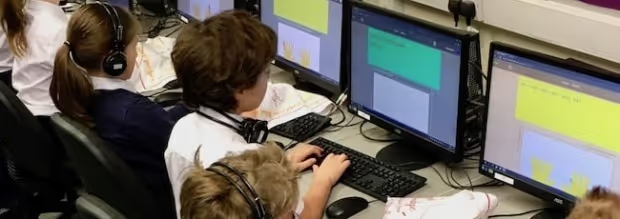
Helen, Inclusion Manager at a junior school
In our large junior school, we offer Touch-type Read and Spell as an invite-only club. Children are invited to participate if they are assessed with dyslexia or dyspraxia, or if their teacher recommends they are included. I have seen a great boost in self-esteem amongst our more reluctant writers, especially once they have built up enough speed and keyboard familiarity to start using a laptop in class for longer writing tasks.
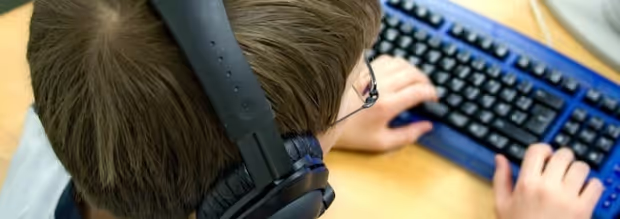
Wendy, Teacher for students with disabilities
I’m a resource teacher for learners with physical and intellectual disabilities. Those students who are struggling the most with literacy, I put on the TTRS course. It helps them learn the letters of the alphabet and then moves them on to building letters into words, and words into sentences. TTRS has become a part of our education program and is included in the targets I set during regular meetings to update and monitor Individual Action Plans.

Roisin, Secondary School Teacher
We have been using Touch-type Read and Spell (TTRS) for nearly three years with all of our transition year students who are 15-16 years old. It has been wonderful to see the improvement in reading and spelling, typing skills, confidence, and motivation in students who are using TTRS. It is also great preparation for those who will complete their Junior and Leaving Certificate examinations through special centres using technology.

Chris, Special Needs Teacher
I’ve found Touch-type Read and Spell is a great way of teaching typing skills while also addressing literacy difficulties. I am a Special Needs teacher in a primary school working with children who are 7-11 years old. The children enjoy monitoring and observing their own progress as they develop their typing skills. They love being awarded TTRS certificates for their progress and attainment!

Alan, Adult with severe dyslexia learning to read
Alan struggles with dyslexia. He spent much of his life avoiding reading and writing. Before beginning TTRS, he struggled to understand even simple text like instructions and signs in shops. When Alan joined a literacy and numeracy class at a local college, as part of his learning program, he embarked on a touch-typing course. With plenty of encouragement and perseverance, he began regular practice with the TTRS program. He learned to type and is now able to read and write most high frequency English words.

Success Stockport, Adult Education
We had run the Touch-type Read and Spell course before within a local authority and found it really inspired confidence in adult learners. That's why we ran it again in our most recent course for 9 unemployed adult learners, some of whom had learning difficulties. Our students enjoyed using TTRS and acquired the skill of touch-typing at the same time. One student said TTRS taught her not to be afraid of computers. Another said learning typing with TTRS made him more confident and that he was now ready to tackle future computer courses.

Elizabeth, Adult learner with dyslexia
I was 15 when I was diagnosed with dyslexia. Because of my early experiences with reading and spelling difficulties, I chose a career in education and I am now a primary school teacher. I think Touch-type Read and Spell is just brilliant because it teaches you to type using real words. It’s all about sensory skills. It teaches typing, reading, and spelling and it’s designed for people who have dyslexia. When you have dyslexia, it’s difficult to learn how to type if the drills aren’t linked with spelling patterns and you don’t get the same benefit out of it, like you do with TTRS.

Brian, Retiree and youth mentor with dyslexia
I was never officially diagnosed as dyslexic, but I’ve read a lot about it and I’m pretty sure I have phonological dyslexia. When I was 9 or 10 I can remember looking at the word off, thinking that's alright. Then looking at the word of, and thinking that should be 'ov' -- this doesn't make sense. At work, when I became a manager, my boss would say things to me like “you take the minutes for the meeting,” and I’d sit there thinking how can I write the rough copy big enough, so that I can read it later, but too small for anyone to see my mistakes as I write?
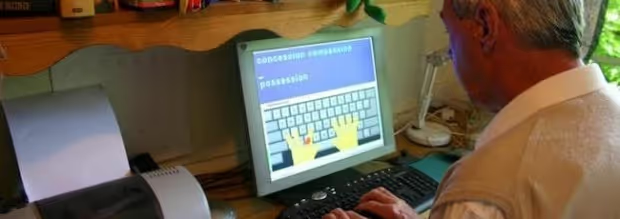
Brian, Retired engineer using TTRS
I worked my whole life as an engineer but I've struggled with severe dyslexia. When I used to do e-mails it was a nightmare, but now, what would take me half an hour I can do in five minutes. It's been two years since I started using the Touch-type Read and Spell course and my reading has improved significantly. In the beginning, one or two modules might have taken me half an hour and I’d try and do that every day. These days I’m much faster and I can do up to ten modules in one sitting. TTRS has given me confidence.