



The Orton-Gillingham approach is a multi-sensory way of teaching reading, spelling and writing skills to students who struggle with language-based learning difficulties, including dyslexia. Lessons focus on mastery of the smallest units of language first, including phonemes and graphemes, and then build to whole word, phrase and sentence level instruction.
Many current reading methods and courses are grounded in this approach, including Touch-type Read and Spell, and it can serve as a guide for tutors who offer literacy skills support for individuals with specific learning difficulties.
Because Orton-Gillingham focuses both on enhancing phonological awareness and teaching English language rules, it can also be useful for English Language Learner (ELL) students.
Commonly described as structured, systematic, sequential and cumulative, Orton-Gillingham takes a bottom-up approach to reading beginning with the smallest units of meaning.
A tutor works one-on-one with an individual, explaining language rules and guiding experimentation with phonics. It necessitates a good working relationship between tutor and student; each lesson is based on the progress a student demonstrates from the previous one. Interaction is key, as is involving diverse sensory channels to help encode new material and enhance recall.
Because no two children with dyslexia will experience the same set or degree of symptoms, the Orton-Gillingham approach is flexible and advocates diagnostic testing to assess where students should begin based on their level of phonological awareness and literacy skills.
Repetition and review are emphasized and learners are urged to continue working with a new unit until the material is mastered and they feel ready to move on.
History of the approach
The Orton-Gillingham approach has been in use for the past 80 years and is the oldest dyslexia specific approach to remedial reading instruction. It was developed in the 1930s by neuro-psychiatrist Dr. Samuel Orton based on his work with children who struggled with language processing issues but were of normal intelligence.
He proposed a neurological basis for the problem and developed a series of activities that combined right and left brain functions, predicting they would positively impact on the children’s ability to read and spell.
Dr. Anna Gillingham, a teacher at Columbia University in New York, focused her efforts on training instructors in the approach, creating materials and expanding the instruction to include essential features of the English language, such as prefixes, suffixes and even spelling rules.
The two published the Remedial Training for Children with Specific Disability in Reading, Spelling and Penmanship in 1935/36 and the basis for today’s approach was born.
How reading works
One of the most important skills to develop in early reading is the ability to map sounds to letters in order to sound out words, a process referred to as decoding. As familiar words are encountered on repeat occasions, learners begin to recognize them by sight which speeds up reading.
In this way, fluency develops along with working vocabulary. Learn more about teaching children to read.
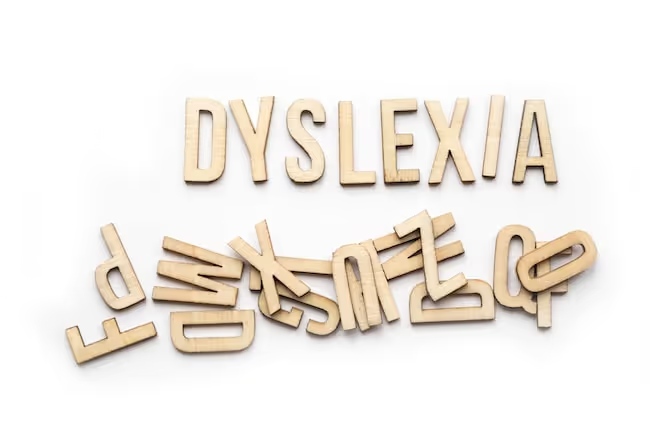
What is dyslexia?
Dyslexia is a brain-based learning difficulty that impacts up to 10% of people in the UK. Of those individuals who are affected, 70% experience phonological dyslexia. This makes it difficult for them to break words into their component sounds and has a direct impact on decoding ability and spelling skills.
Orton-Gillingham works because it enhances phonemic-awareness in dyslexic individuals by examining common language patterns. Learners experiment with blending sounds, looking at letters and word parts in isolation and in various configurations, and studying language features, including diphthongs and silent letters.
The goal of Orton-Gillingham based instruction is to enable learners to decode words on their own and improve literacy skills in order to achieve their full potential at school.
Interested in learning more? Check out our articles on helping dyslexic students in the classroom, spelling strategies for dyslexia, dyslexia and foreign language learning and tips for dealing with dyslexia in the workplace.

Multi-sensory learning
Multi-sensory learning means the eyes, ears and body are all involved in the process of acquiring new information.
It relies on physically diverse channels to help log and reinforce knowledge in memory. Visual content might be displayed in a book, on the board or on a screen while audio is played.
To satisfy the kinesthetic element, students might draw a letter in the air with their hands while saying it out loud or walk and arrange themselves in the pattern of a letter while repeating it.
They can even type a word in response to a visual and audio prompt. This is how Touch-type Read and Spell integrates the approach.
Confidence, motivation and self-esteem
Because Orton-Gillingham is personalized and driven by the individual’s ability level and demonstrated progress, students build mastery one step at a time.
Every student is allowed to work at his or her own pace, which fosters a sense of independence that can enhance motivation and build self-esteem. Learners also develop increased confidence in their abilities, which is particularly important for individuals with learning difficulties.
Orton-Gillingham in action
Often students with dyslexia will benefit from learning keyboarding skills. That’s because typing allows them to use muscle memory in the fingers to remember spelling, provides access to spell-checkers, enhances sight reading skills and gives individuals an advantage on assessment measures which must be taken on a computer.
TTRS is a unique online touch-typing program and method for improving literacy skills. It takes an Orton-Gillingham and multi-sensory approach in which students hear a letter or word, see it on the screen and then type the corresponding keys.
The course is divided into cumulative modules that include plenty of review and allow students to engage in self-directed study, only moving on when they are comfortable and ready. Progress reports build motivation and successfully learning how to type enhances self-confidence.