



Dysgraphia is a language based specific learning difference that primarily affects writing. It can be difficult to spot in young learners, as not every child develops literacy skills at the same rate. Nonetheless, there are some hallmark signs of trouble which usually show up when a child first learns to write.
For example, these children often have problems holding a pen or pencil and forming letters and numbers, both in print and in cursive writing. They can struggle to express themselves in writing, from organizing ideas, to spelling and using punctuation correctly. Poor handwriting is common. The spacing between words may be uneven, letter size can vary and there will be issues staying inside margins.
Students with dysgraphia can find it hard to show what they have learned when an assessment is done via writing. Dysgraphic children also tend to find copying exercises challenging and may avoid coloring and drawing too.
As writing by hand is necessary for everything from putting your name at the top of a page, to making notes, completing worksheets and taking tests, learning can be affected when a child doesn’t get access to the accommodations and strategy training he or she needs.
According to some research, writing problems are present in 10–30% of children at the elementary school level (1). Beyond the third grade, it’s important to have a student assessed if dysgraphia is suspected, to prevent him or her from falling behind his or her peers. The earlier an assessment is obtained, the better.
Undiagnosed learning difficulties can contribute to low self-esteem in learners who may believe they are not as intelligent as their classmates. Moreover, as kids with dysgraphia can be strong readers, their poor performance in written work might be blamed on laziness or “not trying,” which can be even more damaging to the child’s sense of self-worth. It’s essential to prevent the student from creating negative associations with school which, once formed, can be difficult to reverse.
Dysgraphia vs. dyspraxia, dyslexia and ADHD
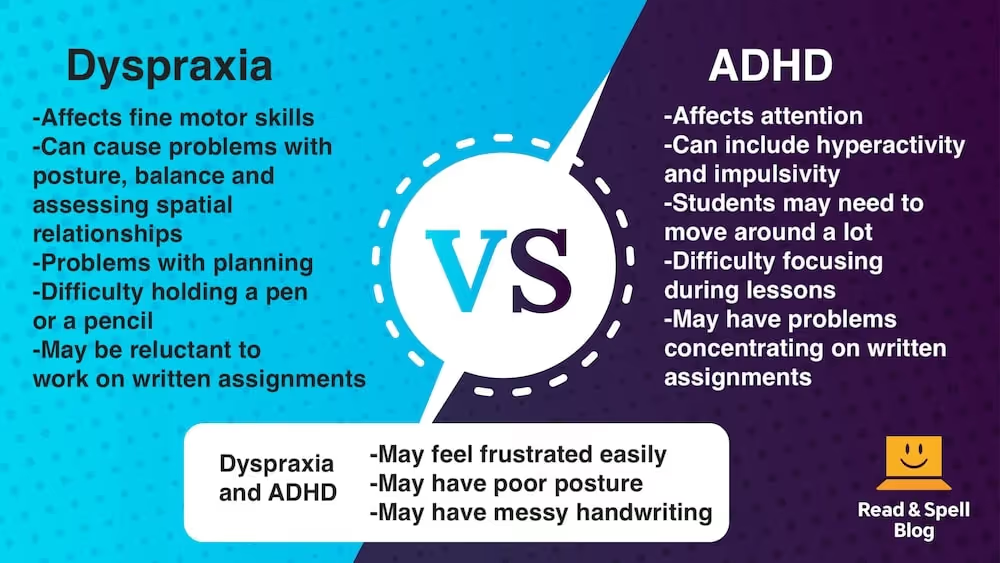
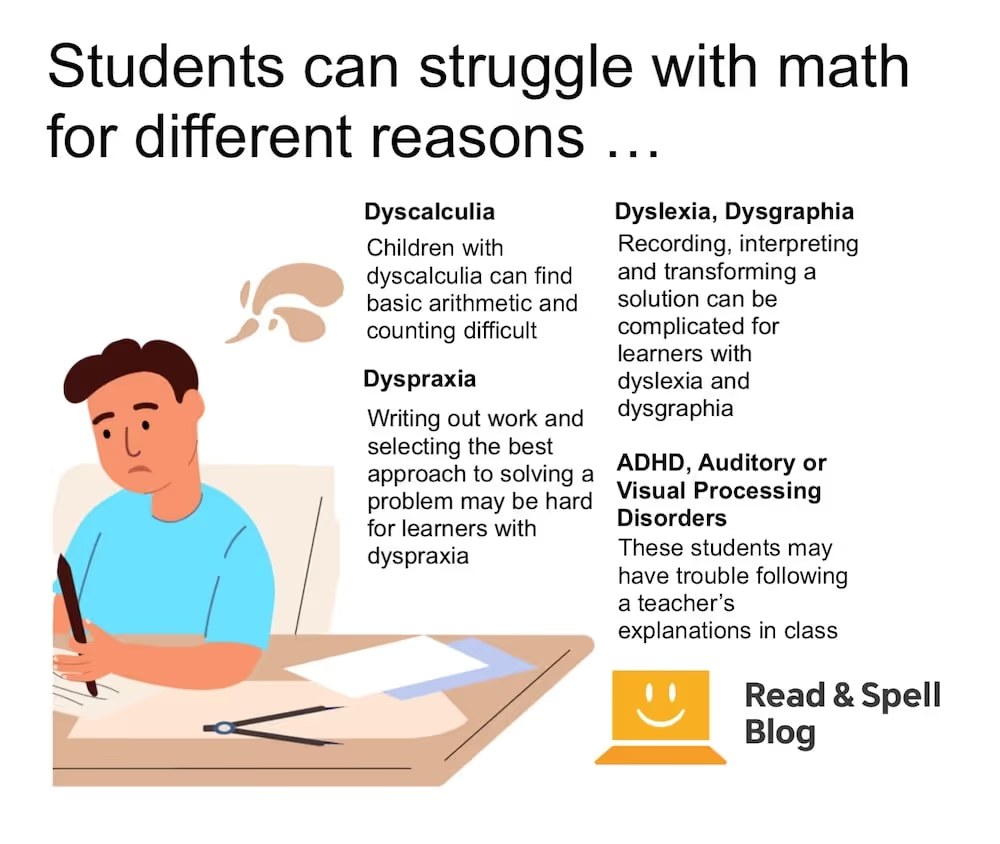
An evaluation can determine if dysgraphia is the cause of writing difficulties. In certain cases, dysgraphia and dyspraxia, a fine motor skills difficulty that causes children to struggle with coordination, can look alike. Both can cause pain and difficulty when writing by hand, as well as problems with planning and organization.
When reading out loud is an issue, the child could also be struggling with dyslexia, another language based learning difficulty that primarily affects reading and spelling.
A word of caution—dysgraphia is not dyslexia. Dyslexic children struggle mainly with reading and spelling. If writing difficulties are present, they’re often a result of phonological encoding issues vs. problems with letter formation. Dyslexia can also vary widely and not all cases are alike.
According to the International Dyslexia Association, "Children with impaired handwriting may also have attention-deficit disorder (ADHD)–inattentive, hyperactive, or combined inattentive and hyperactive subtypes."
Writing is hard
Language first evolved as a system for spoken communication, meaning written language is a relatively new phenomenon in the history of human civilization. Reading and writing are cognitively complex tasks involving a hierarchy of skills which all must be mastered and automatized to allow for fluent reading and written production.
Children begin by learning letter formation, then the encoding of sounds into letters, the organization of letters into words, and finally the putting together of words into grammatically sound sentences. Beyond the sentence level, ideas must be introduced in a logical order and information organized into paragraphs. There is English spelling to contend with (not all words are spelled how they sound) and conventions involving capitalization and punctuation to apply. No wonder it takes students many years to develop strong writing skills!
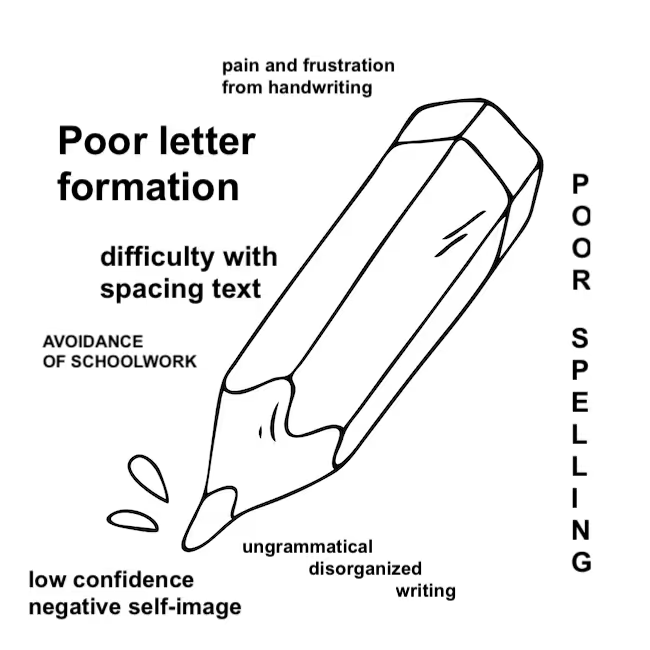
7 Signs of dysgraphia
- Poor letter formation. Understanding how lines and curves combine to form letters can be quite difficult for a child with dysgraphia. He or she may struggle to copy the pen strokes needed to produce a letter and have a hard time with spacing and size. In the beginning, you'll note a child with a specific learning disability often writes letters in a different way from same-age peers.
Not all letters are created equal and lowercase letters tend to be more challenging. That’s because they are made of more curved lines and are smaller, which creates an added challenge for someone who already has difficulty wielding a pen or pencil. You might see letter reversals, writing in all capitals, an inability to produce cursive text and generally hard to read and poor handwriting.
- Pain and frustration from handwriting. Children with dysgraphia (and dyspraxia) commonly complain that writing by hand hurts them. Dyspraxia is not a specific learning disability but it does affect fine motor skills. They may position their wrist and elbow in an awkward way and not be able to hold a pen or pencil using the tripod grip. The paper can slip out from under them and they might bear down excessively as a result of difficulty applying the right amount of pressure.
All of this is distracting and prevents them from getting their thoughts on paper. Keep an eye out for unnatural movements and strained posture too. While there are devices that can help, such as pen and pencil grips to enhance girth, learning how to type is often recommended as a less painful and more efficient method of writing.
- Difficulty with spacing text. This can be the space between letters, between words and/or between sentences. Writing right to left and producing text that runs in a straight line might be problematic, as well as the spacing of numbers and equations in math problems.
Teachers may note a tendency for text to spill over into the margins, words to be split and for kids to run out of space at the end of a page. One of the hardest things for students with dysgraphia to do is write in small boxes—a common requirement of organizational charts from classroom activity sheets. Note that spacing problems in writing are also found in visual processing disorders.
- Poor spelling. The writing process is cognitively taxing for kids with dysgraphia, which makes spelling mistakes more likely to occur. Also, consider that English is a complicated language to spell because there are so many exceptions to rules.
- Ungrammatical and disorganized writing. The higher order functions of writing, such as planning and producing grammatically correct sentences, can be difficult for a child with dysgraphia. Run-on sentences are common, misuse or a lack of punctuation may show up and teachers will generally find written work hard to follow. This is especially true when comparing a child’s ability to relate information when speaking.
- Avoidance of schoolwork. Writing is required for most classroom-based activities and is an essential skill for exams, projects and even homework assignments. Because children with dysgraphia know they are poor writers, they may be reluctant to complete work and can act disinterested or even outright refuse to participate in a project. Teachers commonly see unfinished writing assignments handed in, a failure to do homework, and students who are not motivated or excited about classroom learning.
- Low confidence and a negative self-image. As with other specific learning differences, dysgraphia can cause confidence and self-esteem issues. Students may be embarrassed by their writing ability and poor handwriting and reluctant to work in groups or pairs. Being consistently marked down for written work after having had to work twice as hard to produce a block of text is also both demotivating and discouraging and eventually, a child may develop a negative relationship with school.
When the condition goes undiagnosed, kids may begin to think poorly of themselves and their abilities (2). That’s why educating children as to the nature of their learning difference and then providing access to the tools and strategies they need to overcome challenges is essential. Dysgraphia may be referred to as a specific learning disability, but it doesn't have to be a disability that prevents a child from achieving their full potential.
Additionally, some research has noted children with dysgraphia write with a different rhythm than their peers (3).
For teachers
If you suspect a child is struggling with undiagnosed dysgraphia, the National Handwriting Association advises you contact your school's special needs coordinator who may recommend they see an occupational therapist. This is especially the case beyond second and third grade when early handwriting difficulties experienced by children who do not have dysgraphia become less prominent (4).
It’s also useful for teachers to consider this quick list of tips when working with dysgraphic learners:
- Don’t force them to write on the board
- Provide tablets for text based annotation of worksheets
- Pair dysgraphic learners up with a note-taking buddy
- Allow them to type written assignments or take notes using a computer
- Permit the use of recording devices for class lectures
- Do limit the amount of writing you expect them to produce
- Don’t restrict the amount of time they have to give a written answer
- Evaluate learners on the quality vs. quantity of their written production
- Provide prompts to help them brainstorm and get their thoughts on paper
- Avoid short answer question types on quizzes and include multiple choice
- Don't announce to the class that they have a specific learning disability
- Create oral assessment opportunities so students can demonstrate their knowledge without having to write
How to help a child with dysgraphia
The severity of the dysgraphia often varies widely from one child to another, and no two learners will struggle with exactly the same symptoms. This is often the case when it comes to a specific learning disability. When a child writes letters, have a look at how he or she holds the pencil, but also focus on contact with the paper.
For individuals with dysgraphia, there are materials that can help with the mechanics of writing. Certain types of textured paper stop a pen tip from slipping, graph and lined paper can guide letter formation, pen and pencil grips make writing less painful, and thicker markers and crayons are often easier to hold. These accommodations may also be useful for students who have dyspraxia.
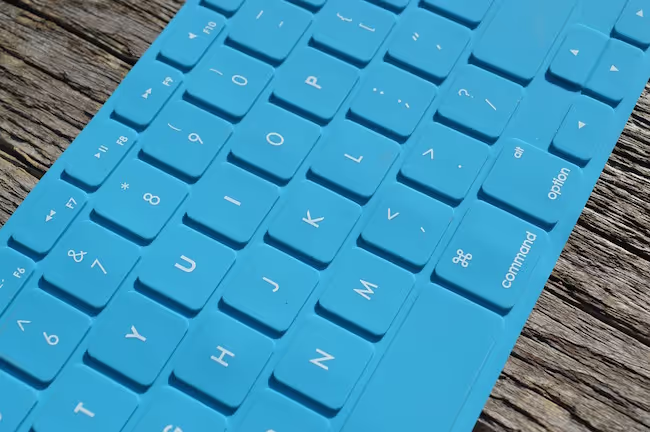
Technology offers a range of tools to help individuals who struggle with higher order functions in writing. Typing eliminates the stress of letter formation and spacing and removes any embarrassment students experience because of messy handwriting or having to turn in pages covered in erasure marks. It helps them get their thoughts on paper, even if this happens via a screen and printer.
In order to increase efficiency in typing and prevent the kind of back and forth visual disruption learners experience when they have to scan the keyboard for a letter, it’s advised that children learn touch-typing. This can be done when they are 6/7 years old and their hands are large enough to rest comfortably on the keyboard.
Typing is also a good solution for students with ADHD and can make a difference when it comes to the quality of a student’s written output. That’s because it’s a skill that automatizes the writing process so words flow through the fingers via muscle memory and more attention can be focused on the thought process and organization of ideas. Check out our article on teaching kids how to type for more information.
In some situations, a child with dysgraphia may not be able to do any writing at all—in which case Speech-to-Text technology is essential to allow the learner to participate at school and create a lasting record of his or her work. Tablets are also helpful as they often contain cameras to photograph paper worksheets and on-screen keyboards which can be used to annotate the images with text and highlighter marks. Parents and teachers can also download apps which provide game-based drills that focus on letter formation, vocabulary learning and word arrangement in sentences.
Typing for children with dysgraphia
Touch-type Read and Spell was developed specifically for children who experience difficulties at school as a result of a language based learning difference. Students have been using it to learn how to touch-type, improve their reading, and strengthen spelling skills for the past 30 years.
Discover a typing platform for students with dysgraphia
A person with dysgraphia often writes letters and spells words in a different way than same-age peers. If he or she learns to write on the computer as well, much of the pain and frustration of letter formation can be relieved. Working memory can also be bypassed as spelling is automatized through muscle memory in the hands and fingers.
Many dysgraphic learners have found the multi-step and multi-sensory approach taken by TTRS has helped them achieve success.
Share your story with us
Do you parent or teach a child with dysgraphia? How did you first recognize the symptoms? Which strategies have worked for you and when were you able to get a diagnosis? Please share any advice you would give to other parents and teachers. We welcome personal anecdotes as well and look forward to hearing from you!
References
- Rosenblum, S., Weiss, P., Parush, S. (2004). Handwriting evaluation for developmental dysgraphia: process versus product. Reading and Writing, 17(5), 433-458.
- Engel-Yeger, B., Naauker-Yanuv, L. & Rosenblum, S. (2009). Handwriting performance, self-reports, and perceived self-efficacy among children with dysgraphia. The American Journal of Occupational Therapy, 63(2), 182-192.
- Sovik, N., Maeland, A.F., & KarlsDottir R. (1989). Contextual factors and writing performance of 'normal' and dysgraphic children. In R. Plamondon, C. Y. Suen & M. L. Simner (Eds.), Computer Recognition and Human Production of Handwriting (pp. 333-347). World Scientific.
- Overvelde, A. & Hulstijn, W. (2011). Handwriting development in grade 2 and grade 3 primary school children with normal, at risk, or dysgraphic characteristics. Research in Developmental Disabilities, 32(2), 540-548.