



With the right support, people born with Down syndrome are living fuller lives today. There is an increased understanding of the potential these individuals have to excel in areas that were previously considered beyond their abilities.
In particular, educational research aimed at understanding early developmental milestones has revealed that teaching children with Down syndrome to read can lead to greater spoken language gains at a younger age.
Early literacy skills development can encourage a preference for reading as a leisure activity later on in life, and an enhanced ability to participate in school activities.
People with Down syndrome are talented, strong and loving. When they receive the educational and/or career training they need, they can lead richer lives as part of their local community.
What is Down syndrome?
Down syndrome is a genetic condition that causes characteristic physical traits, including distinct facial features and short stature. Learning difficulties and developmental delays are often associated with Down syndrome; however, every individual is unique and IQs can range widely.
Down syndrome occurs when an individual is born with three copies of the 21st chromosome, also known as trisomy 21. This can be due to the chromosome not separating in the egg and is detected by early genetic testing.
People with Down syndrome may experience eyesight or hearing issues. Yet health interventions and surgeries, particularly for those babies born with heart problems, have significantly increased quality of life and raised life expectancy, with some individuals living well into their 70s.
Advances in medical technology continue to ensure children born with the condition can live a happy and healthy life, just like everyone else.

Educating children with Down syndrome
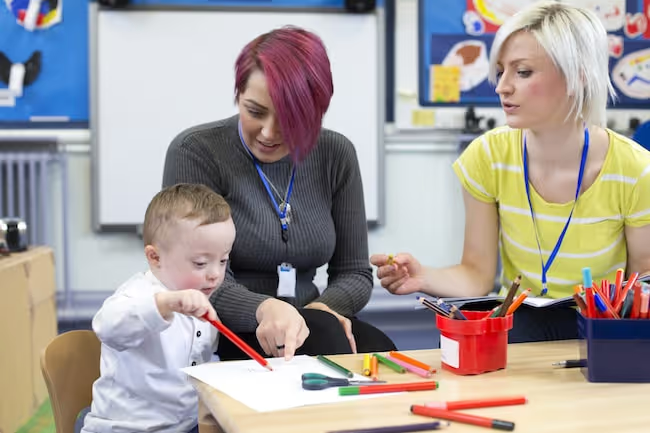
As is the case for individuals with visual impairments, more and more children with Down syndrome are entering regular school systems today. School is important as it provides a rich social environment where they can make friends, play sports, learn an instrument and engage in artistic and creative activities, just like their peers.
Many children with Down syndrome start school in kindergarten and continue on through high school, with some even going on to attend college and university.
Given the range of special educational needs associated with the syndrome, academic environments can sometimes move at too fast a pace for regular study. For this reason, people with Down syndrome tend to spend longer in school than people who don’t have the condition.
As every individual is different, depending on the student’s abilities, they may attend regular classes or receive additional special needs training to help them in areas of the curriculum that are more challenging.
Using computers to teach literacy skills
People with Down syndrome experience greater confidence gains and heightened self-esteem when they are able to proceed through a learning program at their own pace. Breaking academic goals into step-by-step challenges is key, as is allowing individuals to see and measure their progress.
Computers are excellent tools for learners with Down syndrome as they cater to visual learning but also help strengthen listening skills through auditory prompts. Programs may contain plenty of built-in feedback, encouragement, rewards, and praise, which is delivered when goals are met.
Furthermore, computers never get bored with repeating the same information over and over if this is what the student needs.
TIP: A great way to teach early reading, writing, spelling and even motor skills, such as enhanced finger manipulation, is through a touch-typing course.
Discover a typing program for learners with Down syndrome
TTRS’s Touch-type Read and Spell program has been successfully used to help learners with Down syndrome enhance letter recognition, improve concentration and achievemore advanced spelling, reading and computer skills.
Learn more about teaching children with Down syndrome to read.
Down syndrome facts
Early literacy skills
Children with Down syndrome who are as young as 2 have been taught to read single words on flashcards. Researchers in the 1980s and 90s did numerous qualitative studies in which they taught children ranging from ages 2-9 to read individual words, recording the process and measuring the developmental progress following the interventions.
Results were extremely positive and showed the children became stronger readers as teenagers. This was true even when interventions occurred later on at ages 8 and 9.
Visual learners
Babies begin learning the sounds of their mother's language before they are born and infant babbling is an opportunity for children to practice forming phonemes. Yet because high rates of hearing loss are observed in infants and toddlers with Down syndrome, this can mean these children are often stronger visual, as opposed to auditory, learners. This may also be responsible for delays in first language acquisition due to physical, not mental challenges.
Sign language
Children with Down syndrome who are taught sign language often find it's a faster mode of expression than speech, particularly when articulating sounds is the cause of delayed responses in speech production.
Phonics training
Just like individuals who have dyslexia, people who have Down syndrome can benefit from phonics training in which they learn sound-letter mapping skills. This often goes hand in hand with spelling instruction, which in turn contributes to reading and writing skills development.
Semantic mapping and decoding skills
While grammar can sometimes be challenging for people with Down syndrome, semantic associations and decoding skills have been observed in early language acquisition. In an experiment in which children with Down syndrome were taught to read specific sight words, some misidentified vocabulary using semantically related words as answers.
Given there were no additional visual cues provided with the words, this points both to successful decoding of language and strong semantic mapping in the mental lexicon.
Do you have any interesting facts about Down syndrome to share? Send us an email and join the discussion.