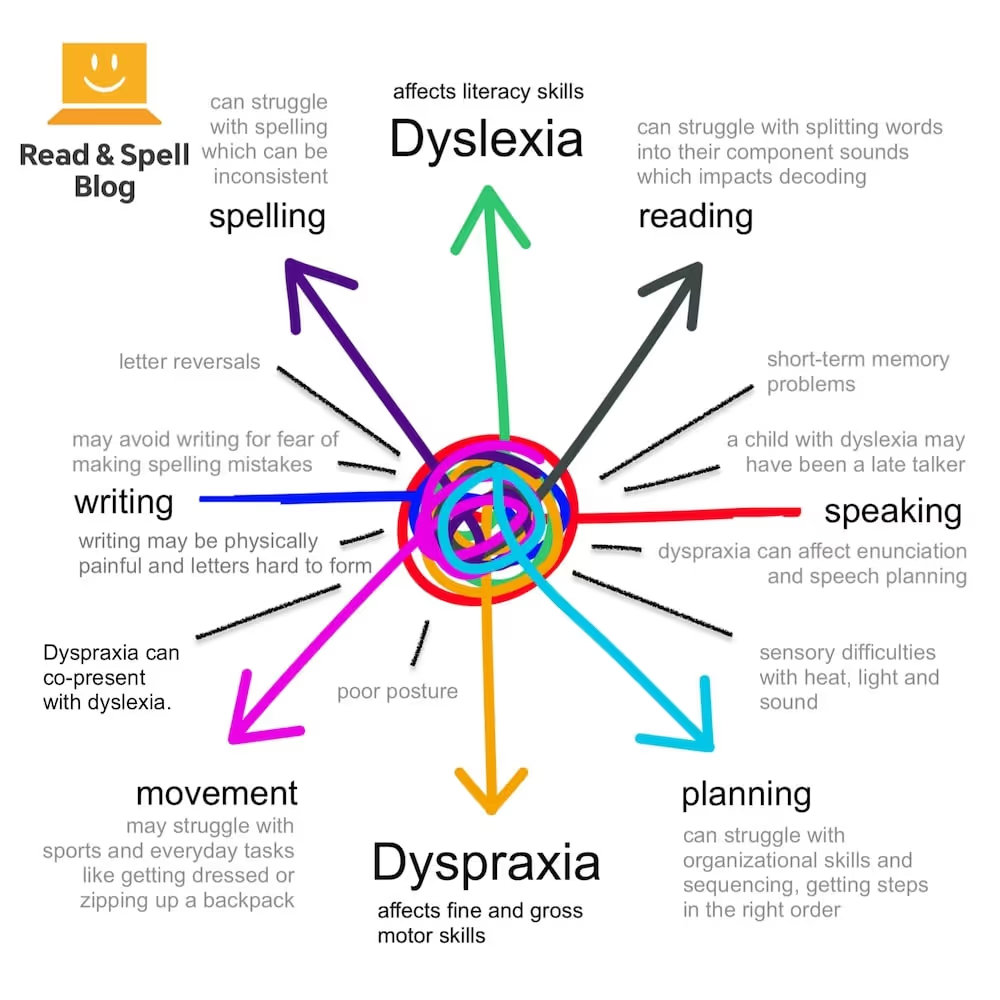




There a number of reasons why a child may need to attend a special education program at school. Special education can help learners who struggle with developmental delays, such as dyspraxia or apraxia of speech, and/or children who experience challenges with literacy and numeracy because of a specific learning difference.
It may also be that a physical impairment is affecting a student’s ability to learn in the same way as his or her peers and specific accommodations and materials are necessary. The basic requirement for a program to be considered special education is that it must address the individual learner’s needs in a way that wouldn’t be possible in a mainstream classroom. But just because a child receives extra support, it doesn't mean they are less intelligent or talented than their peers.
That’s why one of the most important ways a parent or teacher can assist a child in special education is to focus on helping them find their strengths. For example, learners with dyslexia may have a hard time with reading but be extremely creative artists. Or a child with autism might struggle with interpersonal skills but be a whiz on the computer.
As every learner is unique, it’s also key to introduce targeted strategy training that can help with skills development, and to provide access to the right accommodations, such as special pen and pencil grips for learners with motor skills difficulties who find it hard to hold a writing utensil, or a calculator for a child with dyscalculia who struggles with arithmetic.
Lastly, it can take a lot of physical and cognitive energy for some children to overcome the challenges posed by their difficulties / disabilities. If studying is emotionally and mentally draining, plenty of encouragement and motivation are needed to prevent a child from developing a negative attitude toward school and learning.

What counts as special education?
Many students in special education spend most or part of their school day in regular classes. It may just be they attend their program in the morning or afternoon, or have a designated teaching assistant in class to support them. When support occurs outside of the regular classroom it may be referred to as “pulling out,” whereas providing individual attention in a regular classroom is “pushing in.”
Different students can benefit from different kinds of support and it will be up to the child’s educational psychologist or SEN co-ordinator (SENCO) at the school to recommend the mode of instruction they think will work best. Social factors such as a child feeling embarrassed about needing extra attention or finding a regular classroom too distracting will factor into this decision.
In certain cases, a child and his or her parents may decide it is better to attend a private institution where all of the students have a specific learning difficulty vs. taking part in a special education program within a mainstream school.
Benefits of changing schools might include a student feeling more comfortable among peers if other children have the same or similar specific learning difficulties/ disabilities. In a specialist school, instruction is also delivered in a more flexible way. For example, in dyslexia schools much of the learning across subject areas is multi-sensory. Learn more about specialist dyslexia schools.
Special education differs from remedial education in that the former is for learners who struggle with disabilities or impairments, whereas remedial education is for any learner who may have fallen behind in the basic skills areas of the school curriculum, regardless of the cause. Some students may attend special education classes as well as a gifted education program if they are advanced in certain areas but need support in others.
How to help learners
1. Help them find and develop their strengths. The key to inclusive special education programs is understanding and accepting students for who they are. This means not just helping them overcome their weaknesses but assisting them in finding and developing their talents too. Some people associate special education needs with lower intelligence but this is not necessarily the case. Every student, no matter what learning difficulties they have, has strengths, even if he or she hasn't found them yet! Learn more about the strengths associated with dyslexia and ADHD strengths in these articles.

2. Provide the right strategy training and accommodations.
No two individuals are alike and this is especially true when it comes to students who struggle with physical impairments or specific learning differences such as dyslexia, ASD, and ADHD, where a wide spectrum of ability can present. Most diagnostic testing results in a report in which recommendations are made for strategy training that can help a student cope with any issues he or she is experiencing. It may be that certain accommodations are also needed, such as typing on a computer instead of writing by hand or reading worksheets printed on a particular color paper in a special font. What’s important is to review the progress a child is making periodically, so strategy training and accommodations can be adjusted to ensure the maximum benefit to the learner. Learn more about diagnostic testing for dyslexia.
3. Motivate and encourage.
Many learners in special education programs have to work harder than their peers to achieve the same results. School can be exhausting physically, mentally and emotionally. That’s why it’s so important to provide plenty of motivation and encouragement, especially to children who struggle with a specific learning difference that is hard to see. The worst-case scenario is that a child finds school difficult and begins to avoid learning as a result. You might try finding role models in successful individuals who have overcome a similar challenge, or use what you know about a child to find the points that drive them to achieve their best. Read more about motivation in these articles: The importance of motivation, Motivating learners to read, What motivates students to learn?
Why the language you use matters
In many countries, including the US, it is still common to hear the term learning disabilities used by both teachers and administrators in special education programs, as well as by parents and the learners themselves. Nonetheless, in the UK common usage is moving away from disabilities, which has a negative connotation, in favor of learning difficulties and learning differences.
The latter are more descriptive of the problems a learner faces, which can be challenging but still overcome, or the fact that someone who has been diagnosed with dyslexia or ADHD is not less able than his or her peers, they simply learn in a different way.
Avoiding the term “disabilities” also means students are less likely to struggle with low self-esteem as a result of being told they are “disabled.” Every child has strengths and weaknesses and it’s crucial to focus on areas in which students excel, as well as where they may need extra support. Learn more about encouraging learners with learning difficulties and the difference between self-esteem and self-confidence in these posts.
Study habits outside of school
Students in special education programs may require different teaching strategies during the school day, but they can also have particular needs when it comes to study habits at home.
Consider the kind of homework students do.
Many children will benefit from increased opportunities to repeat previously learned material. This means instead of working on a new problem set at home, or doing some reading to inform the next day’s lesson, it may be better to review familiar material instead. They might repeat the same problem set they completed in class or go through a worksheet again, only this time on their own. Repetition is an excellent way to reinforce learning and help new concepts and facts make it into long-term memory. It can also boost confidence and self-esteem as the challenge level of working through a problem decreases with increased practice.
Consider the way in which learners do their homework.
For some special education students, it’s important they be allowed to complete homework using a computer for writing, text-to-speech technology for reading, or a calculator for doing basic arithmetic. This might be because a learner struggles with dyslexia, dysgraphia or dyscalculia. There is no shame in making use of technology and it should in no way be seen as “cheating.”
Think about how much work they should do and how long they should spend on it.
Many students in special education have to work harder than their peers to achieve the same results at school. They may feel frustrated by the constant challenges they face. That's why after a long school day, sometimes kids just need a break – a chance to recharge their batteries instead of jumping right back into more exercises and drills. This is especially true of learners with dyslexia and attention difficulties. Homework shouldn’t take more than an extra hour or two at night and it’s recommended the amount of work required be based on a learner’s ability levels and agreed upon learning targets.
Touch-type Read and Spell
In some cases, it’s useful to introduce an alternate program, one that teaches a new skill but also supports a student’s basic abilities in reading and writing. Touch-type Read and Spell is a multi-sensory typing program that was developed specifically for learners with dyslexia and then adapted to support students with a variety of learning difficulties and physical impairments. It can help a student make better use of recommended accommodations and write more efficiently and fluently on the computer.
Discover the TTRS approach to literacy and typing!
Because it is typing plus reading and spelling, TTRS is also informed by a program of phonics that helps students to internalize the basics of English grapheme-phoneme mapping, which results in enhanced decoding ability, more reliable spelling skills, and improvements in sight reading.
TTRS is self-paced so no child feels left behind and includes plenty of built-in feedback to encourage and motivate. The curriculum is modular in design; learning takes place gradually and in bite-size steps. Students focus on accuracy before speed, which is particularly important when language disabilities or motor skills difficulties are present.
Many learners report increased confidence and self-esteem as a result of regular use. Explore our website or get in touch with our team to learn more about the program!