



Specific learning difficulties affect a significant percentage of the population – and dyslexia alone can affect up to 10% of us – 4% severely so. Teachers who aren’t trained to recognize the signs of specific learning difficulties might unintentionally harm a student’s self-esteem.
"If he’s good with words and he’s not performing academically, and if he can’t spell today what he spelled correctly yesterday, he must be being uncooperative or not trying."
Some educators and social commentators point to an association between being from a deprived socio-economic area and an anti-school culture. Education’s not cool, playing the class clown, being disruptive, answering back, and being part of an anti-learning peer group is.
However, educators from the world of specific learning difficulties or differences often see this behavior as more of a defense mechanism that hides an inability to read or spell.
Recognizing dyslexia in the classroom
You can have a highly intelligent child or young person who is obviously bright and articulate, creative and spatially aware, but who struggles with reading, spelling and writing, and feels humiliated by being asked to read out loud.
Let’s call him “he” as currently more males than females are identified as having specific learning difficulties (and, incidentally, a disproportionate number of these males are left handed). He doesn’t want his friends to find out how much he struggles with reading. He doesn’t want them laughing at him, or calling him thick or stupid, and so he acts up in class.
Tell him often enough that he’s not trying hard enough, embarrass him by expecting him to copy from the board or read out loud, mark him down on his assignments because of poor spelling, and you could be contributing to a self-fulfilling prophecy.
Here is an illustrative example: one mother reported how devastating it was for her dyslexic son, whose one area of strength at school was PE/gym class, when he was graded down for having poor spelling on a written exercise. This is cruel irony and it illustrates the important role parents have in raising teacher awareness – which in this case she did.
The good news is early recognition and intervention, the adoption of “dyslexia friendly” teaching strategies, and help in identifying the coping strategies that are right for a particular student, are likely to turn school and classroom failure into success.
It’s appropriate to underscore that the intelligence of students with specific learning difficulties and their ability to learn is not in question. It is their performance and achievement that may be affected by an inability to cope – that is, learn from - aspects of the traditional learning process. That’s why some experts in the field prefer the term “learning difference” to “learning difficulty.”
Dyslexia friendly teaching
Many children with specific learning difficulties will struggle to learn when on the receiving end of traditional teaching methods. However, an approach which is “dyslexia friendly” works for everyone.
This approach might include multi-sensory teaching or small incremental steps delivered one at a time, with plenty of opportunity for repetition, so learners can proceed at their own pace and receive positive reinforcement as they learn. Each child is, of course, different and this will have consequences for the way in which they learn best.
1. Note taking
Copying from the board can be extremely difficult for students with specific learning difficulties. For the dyslexic student who struggles when reading printed text, deciphering someone’s handwriting can present an additional challenge.
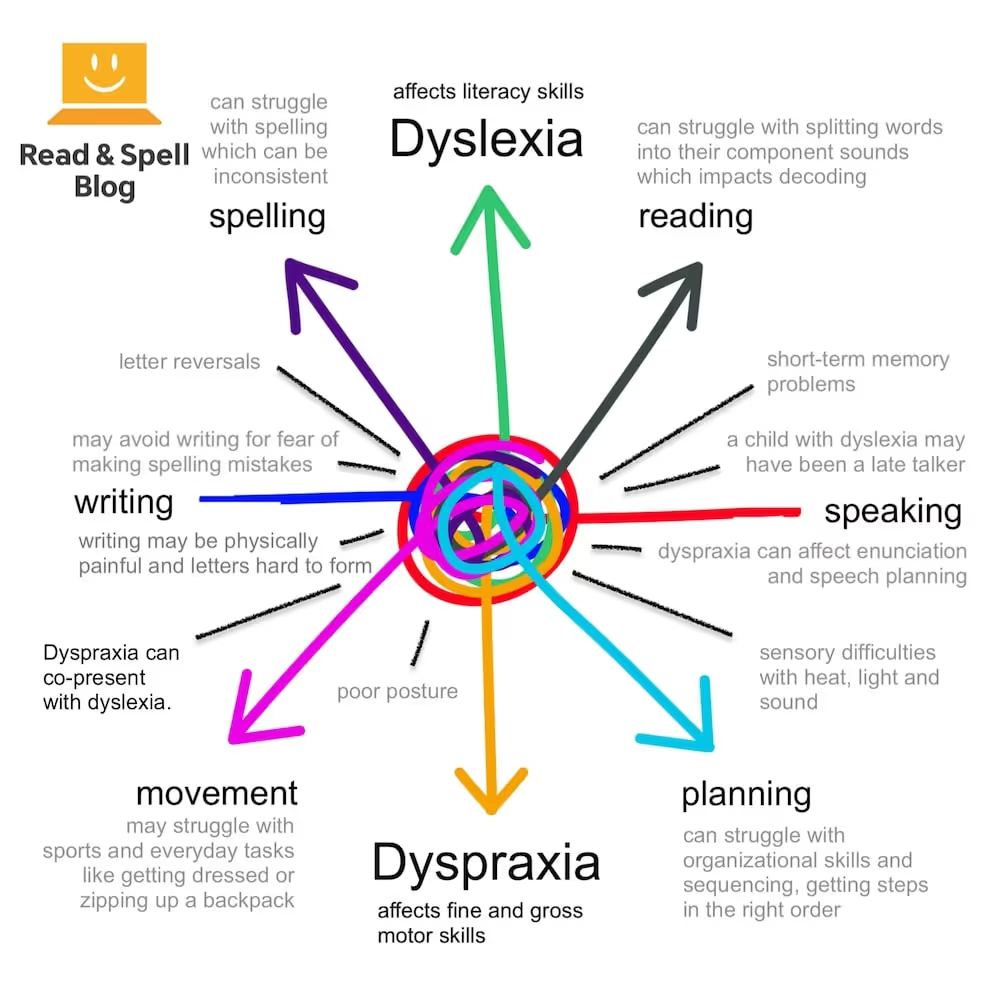
Add to that a difficulty with the physical process of writing, something often seen in students who have both dyslexia and dyspraxia.
After decoding the word, the dyslexic student may have to consciously concentrate on the shape and direction of each individual letter, taking their attention away from what is being said by the teacher.
The student who has short-term memory issues may only be able to deal with a word or small parts of a phrase at a time, and the ability to work at speed may well be an issue. So when the student looks up again, and quite likely struggles to find the correct place on the board, all of this takes so much time that the teacher has erased the information and moved on.
When it’s time to revise, the student has incomplete notes and may even struggle with reading his own writing. A buddy system for good note taking can help, and additionally, reinforce learning.

2. Making written material dyslexia friendly
Teaching strategies for helping students with specific learning difficulties to succeed can include the teacher providing the student with written notes for each session so that having to copy from the board is not an issue.
Keep the following in mind:
- Bullet points may be more useful than blocks of text.
- Dyslexic students may have particular difficulty with print that is black on white. If possible use a pastel shade for hand-outs. There is no consensus on which color is best, but off-white/beige is particularly popular.
- Don’t justify the right hand margin.
- Choose a clear font that makes reading easier for dyslexic children, such as Arial and a font size of at least 12 point.
- Include a vocabulary list of keywords that will facilitate reading.
3. Presenting information to students
Give an overview first, present the information, then summarize what you have covered. Ask students to verbally summarize what they have learned.
4. Study skills and strategies
To get information and ideas on paper, the learner may find mind maps and spider diagrams helpful. Writing frames can help with organization. Encourage the student to use highlighter pens for key concepts. Using a ruler under a line of text when reading can help those students for whom words move around on a printed page.

5. Writing and spelling
Mnemonics can help with spelling difficult words the learner always struggles with (such as Big Elephants Can’t Always Use Small Exits to remember the spelling of “because”). Learning sight words may also help with spelling, writing and reading.
Here are some additional things to consider:
- Some students will benefit from having a fatter pen or pencil to hold
- It is becoming more common to allow students to use laptops in the classroom. A disorganized student who frequently loses his notes will benefit from having course material sent via email.
- A particularly useful skill for the dyslexic student to master is touch-typing. While the student may always struggle with handwriting, touch-typing can become automatic and just flows through the fingers without conscious thought. The student works faster, and can cope with more information. Touch-typing can have the added benefit of introducing automatic access to spell checkers and improving reading comprehension skills.
Discover a typing program for students with dyslexia
Resources for students at home and at school
Touch-type Read and Spell aims to improve reading, writing, spelling, computer keyboard skills and self-esteem by teaching touch-typing in a dyslexia friendly way.
Furthermore, teachers or teaching assistants don’t have to have a qualification in working with students with specific learning differences to be able to deliver the course effectively.
Send us an email and join the discussion!