


Haven’t heard of the Dolch list? Don’t worry. If you’ve ever read Dr. Seuss you know a good portion of it already. In fact, every word in The Cat in the Hat is on the Dolch list.
Dolch words are high frequency English vocabulary commonly used to teach children to read. Learning to recognize them automatically can facilitate fluency in reading.
Think of the most common English articles, prepositions, conjunctions, adjectives, adverbs and verbs (a, and, away, big, blue, can, come, down) and you’ll get a good idea of the list.
Who can benefit from Dolch words?
Dolch words, also known as sight words, account for between 50-75% of all vocabulary found in grade school reading material.
However, it isn’t just grade school children who can benefit from learning the Dolch word list.
Individuals with dyslexia and other learning difficulties may find memorizing the list a useful activity because it facilitates the development of reading and spelling skills.
Adults who are struggling readers can also benefit from learning Dolch words. Those students who are learning English as a second or additional language may be tasked with mastering Dolch words in beginner level classes.

Who wrote the Dolch word list?
The Dolch word list was created by Edward William Dolch in 1936 and first published in Problems in Reading in 1948. Dolch worked at the University of Illinois and based the list on the most common words in children’s books at the time.
This was a genre he was familiar with given he wrote and published many collections of stories, including interpretations of Aesop’s fables and even a title today’s Internet would fall head over heels for, I like cats: True cat stories.
Dolch recognized the value in teaching first-grade readers high frequency words without forcing children to memorize a list of 500+ terms.
He narrowed his collection to 220 words and chose to leave nouns off of the list. The reason behind this decision was that nouns tend to be related to specific content and the more generic “service” words could be found across many different kinds of books and reading materials, regardless of topic.
Dolch later released a list of 95 Dolch list nouns, which can be used in beginning reading instruction as sight words that most facilitate comprehension.
Learn more about teaching children to read and 6 important pre-literacy skills.

Basic sight words in reading
Children who are learning to read at a first-grade level must first decode words on a page. This involves mapping phonemes to graphemes, also known as sounding out words—a challenging activity in English given the irregularity of the language’s spelling.
Dolch recommended that his list be memorized so children could immediately recognize the words they most frequently encounter without having to sound them out.
This recognition process mimics the way we read language as adults.
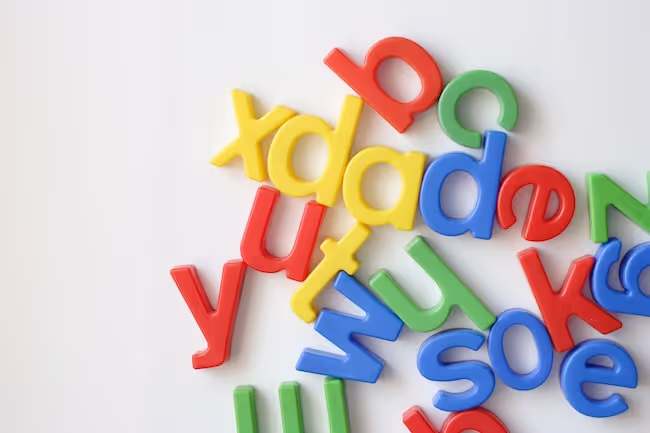
Have you ever been asked to read a paragraph where all of the words are spelled incorrectly? As long as the first and last letters of the word remain intact, the internal letters can be scrambled into any order and it is still possible to read the paragraph normally.
This is because adults do not sound out words, rather they sight read.
Adult reading is about recognizing the collection of letters that make up a word and then scanning the mental lexicon for the best meaning candidate, based on the context in which the word appears and the topic of the text.
Teaching Dolch sight words
While teaching reading to children starts with the decoding process, as children begin to recognize more words, they gradually transition to sight reading. Sight reading speeds up reading and frees up cognitive resources so they can be used to process less frequent vocabulary and enhance comprehension.
TOP TIP: Did you know both in first and second language reading, individuals need to be able to recognize 90% of the words in a sentence in order to make good guesses and acquire new vocabulary from context? (1)
Learn more tips and strategies for teaching sight words.

Dyslexia and sight words
In addition to children and beginner readers, the Dolch word list is particularly helpful for individuals with dyslexia and other learning difficulties.
For people without dyslexia, vocabulary size and literacy skills go hand in hand: reading is the most effective way to build breadth and depth in vocabulary and having a larger vocabulary greatly enhances reading comprehension skills.
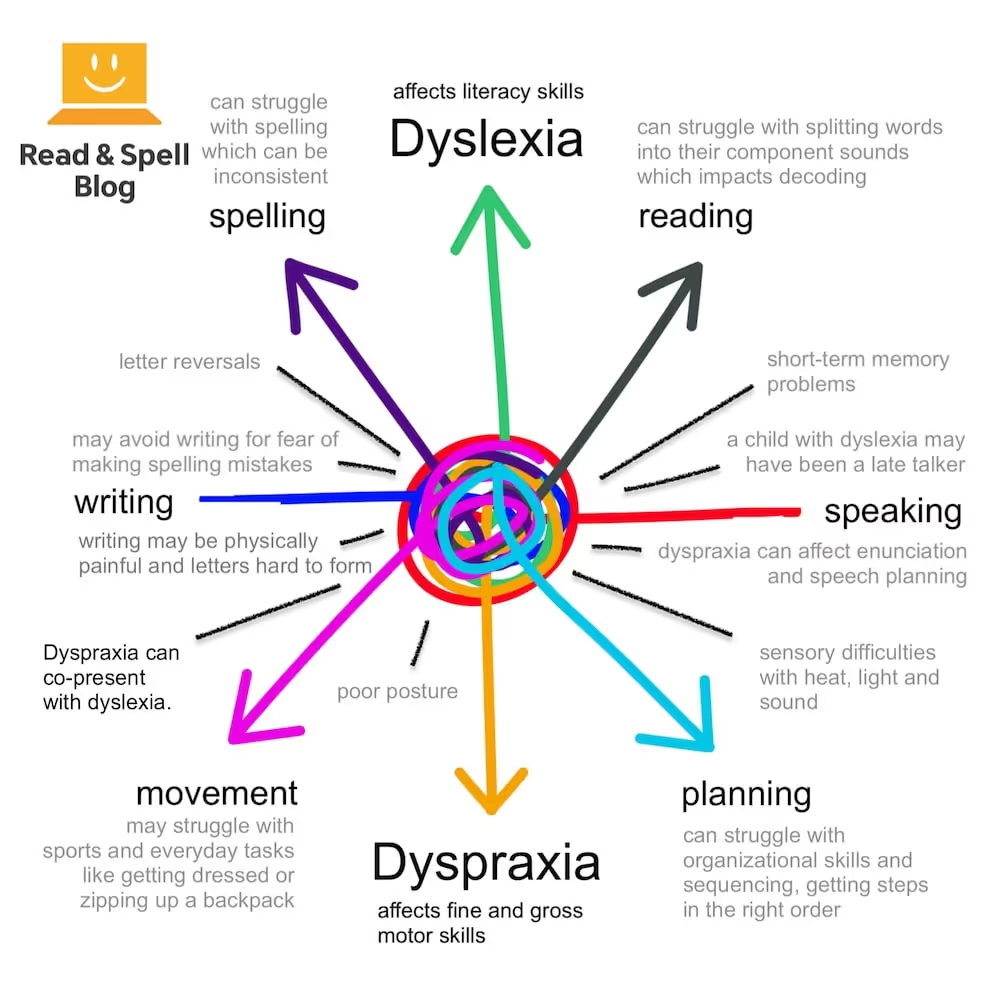
Yet dyslexia affects the initial stages of language decoding and can cause learners to struggle with activities involving reading and spelling. Sight reading helps dyslexic students skip the decoding process.
Why Dolch words are hard for children with dyslexia to learn
Individuals with dyslexia may struggle to read even the most frequently encountered words. As Dolch words are often abstract service words, they can be harder for dyslexics to learn to spell compared to concrete nouns, which may be more easily linked to an image or mnemonic device.
When short term memory is an issue, a strategy for learning Dolch words might involve repetition and multi-sensory teaching.
Touch-type Read and Spell
The TTRS course is a multi-sensory typing program that teaches keyboarding and reinforces literacy skills at the same time. One of the main goals of the course is to enhance frequency of exposure to sight words. They are included in early modules and featured in a specific Dolch words subject.
A learner sees the words on screen, hears them read aloud, and types them. This creates a more lasting and dynamic memory and helps with learning.
While TTRS was originally designed to help dyslexic learners acquire typing skills, it can be used to help any child or adult with literacy and typing.
Adult learners and EAL pupils
Learning high frequency words, including Dolch sight words, facilitates reading and listening comprehension skills in adult, EAL and EFL education.
Time is power in reading, and familiarity with sight words allows adults with poor reading skills, as well as English as a second language learners, to read more quickly and focus on the less frequent vocabulary in texts.
Have you studied or taught the Dolch sight words? Please share your experience with us!
References:
(1) Nation, I.S.P. (1997), Vocabulary size, text coverage, and word lists, in Schmitt; McCarthy, Vocabulary: Description, Acquisition and Pedagogy, Cambridge: Cambridge University Press, pp. 6–19.