


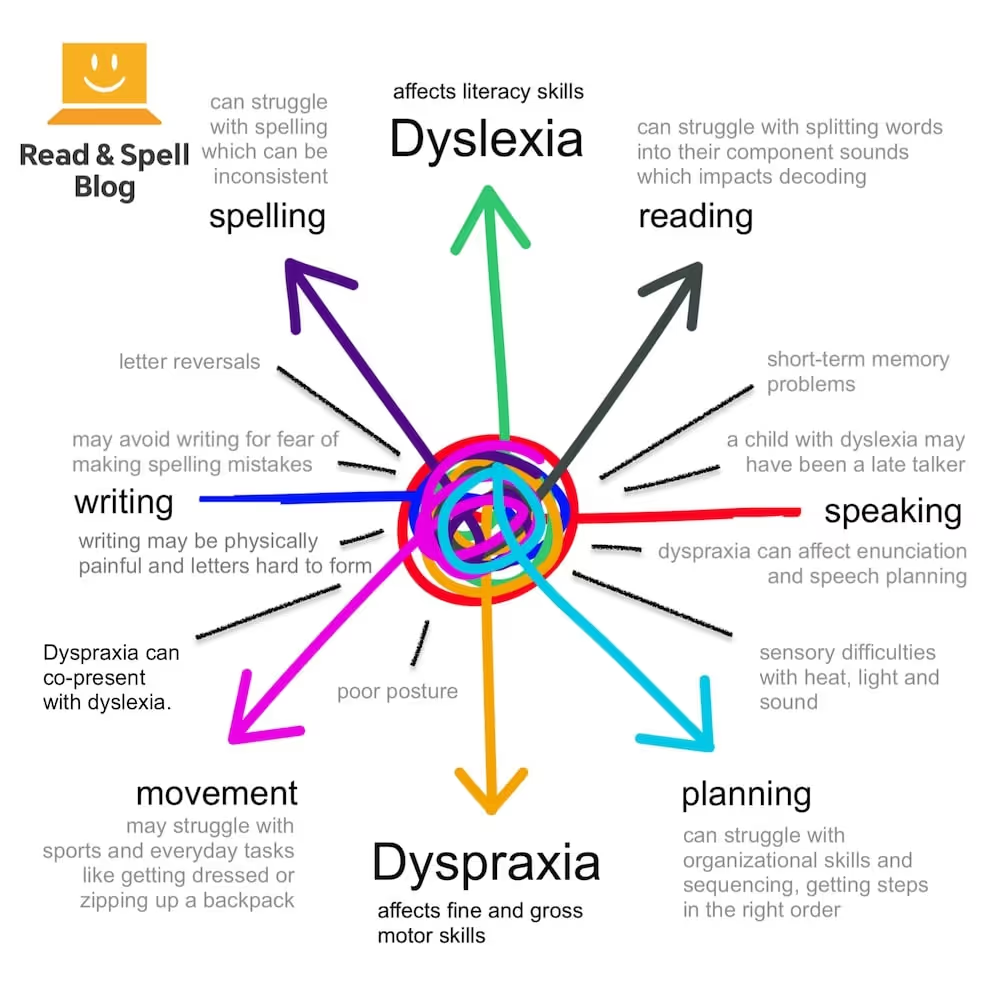
Both dyslexia and dyspraxia can cause children and adults to struggle at school—so what’s the difference between them? In general, students with dyslexia experience difficulties with literacy skills such as reading, writing and spelling. On the other hand, dyspraxia is more about movement and planning difficulties.
However, as both terms are used to describe a collection of symptoms that can vary greatly between individuals, perhaps a more important question is what do dyslexia and dyspraxia have in common.
Did you know that co-morbidity is common for many people who are dyslexic? According to one study (1), 53% of people with dyslexia also have dyspraxia. But let’s start with a proper definition of each, and then take a look at where they overlap.

What is dyspraxia?
Dyspraxia is often used interchangeably with Developmental Coordination Disorder—or DCD—but according to the Dyspraxia Foundation USA, they’re not exactly the same. Technically, DCD is the official medical diagnosis used in the US—it describes difficulties with motor coordination that impact daily life. Dyspraxia, meanwhile, is more widely used in the UK and is a broader term that can include not only motor challenges but also issues with planning, sequencing, and even speech. So, while dyspraxia is technically a motor skills disorder, it often goes hand in hand with challenges in memory, planning skills, and learning.
It can affect everything from preparing, to organizing and performing movements, sometimes extending into speech ability. Dyspraxia can upset articulation of spoken language as well as thought process and perception.
Symptoms in young children may present as developmental delays, feeding and sleeping difficulties, high sensitivity to noise and a lack of interest in construction toys, including building blocks and Legos. Adults can lack hand-eye coordination, have poor balance and struggle to grasp small objects or perform daily grooming routines.
Compromised coordination can have a negative effect on everyday activities for individuals with dyspraxia, causing difficulties with writing and drawing at school, as well as recreational activities including riding a bike and driving a car.
When it goes undiagnosed, dyspraxia may undermine an individual’s academic performance and limit career opportunities later in life. Learn more about how to help dyspraxic children in the classroom.

What is dyslexia?
There is some controversy over the definition of dyslexia, but in 2007 the British Dyslexia Association Management Board accepted the following: Dyslexia is a specific learning difficulty that mainly affects the development of literacy and language related skills. It is likely to be present at birth and to be life-long in its effects. It tends to be resistant to conventional teaching methods, but its effect can be mitigated by appropriately specific intervention, including the application of information technology and supportive counseling.
Individuals with dyslexia can struggle to process the phonemes (sounds) that make up words and can sometimes take longer to perform routine language tasks such as decoding in reading and spelling in writing. Dyslexia can also impact working memory.
Dyslexia is the most common of the specific learning difficulties, affecting up to 10% of the population – 4% severely so. Other specific learning difficulties include dyscalculia and dysgraphia. Learn more about teaching strategies to help dyslexic children in the classroom.
What do dyslexia and dyspraxia have in common?
Dyslexic and dyspraxic children and adults tend to be holistic problem solvers and intuitive, creative thinkers. It’s important to note that neither condition affects intelligence. Nonetheless, they both impact learning styles which involve memory and organizational skills.
People who are dyslexic and dyspraxic might find learning takes longer and is more tiring than it is for other individuals who don't struggle with specific learning difficulties. That's why students will often benefit from identifying how they learn best and developing personalized strategies vs following traditional classroom approaches.
There are even general teaching practices and learning materials now labeled “dyslexia friendly.” A “dyslexia friendly” approach includes multi-sensory learning delivered in small incremental steps, at the learner’s own pace and with plenty of opportunities to repeat and receive positive reinforcement. Everyone can learn from an approach that is “dyslexia friendly,” including children and adults with dyspraxia.
When dyslexia and dyspraxia go undiagnosed, frustration and failure in school are more common and more likely to affect self-esteem. Early recognition and appropriate interventions will help ensure students achieve their full potential.

Helpful interventions for improved literacy and writing
Keep in mind, individuals with dyslexia and dyspraxia can have good days and bad days and both children and adults often show a discrepancy between their oral ability and their written work. This can lead to them being unfairly labeled as not trying or lazy.
Written work may be poorly presented and they may have difficulty copying from the board, but learning to touch-type, so writing becomes automatic and spelling is stored as muscle memory in the fingers, can be extremely helpful. Typing notes in class, essays at home and even test answers can put students with dyslexia and dyspraxia on equal footing with their peers.
The only issue is not all typing programs cater to users with special needs.
That's why the Touch-type Read and Spell platform was developed, to help students with dyslexia strengthen their literacy skills and build self-esteem while they learn their way around the keyboard. It does so in a unique and customizable way. The curriculum itself is a phonics course that not only teaches which finger to use for which letter, but also presents groups of words that share spelling patterns. There are no nonsense key combinations and learners progress through a series of 31 modules per level, with content gradually increasing in difficulty and expanding in scope to cover the basics of English spelling. Students with dyslexia can enhance the readability of the on-screen text, hear accompanying audio and proceed through the course at their own pace.
In initial observations from a Nottingham Dyslexia Association study, which involved both dyslexic and dyspraxic students, the following was witnessed: “Observing the fidgety somewhat clumsy, often impulsive learners who tumble into the program crashing about on the keyboard and jumping up to take breaks (the kinesthetic learners) is interesting. They are the fiddlers in the classroom whose legs tap the chair or who doodle on books. Once they understand the program and ‘feel’ their way through the first three weeks, calm descends. These tactile learners show impressive touch-typing skills and increased concentration. Of all the students these reap the most rewards, both parental admiration and self-esteem. Perhaps sitting still, paying attention, concentrating and achieving are new experiences.” --Initial observations on TTRS, Vanessa Charter for Nottinghamshire Dyslexia Association Trustees
Ready to get started and see how Touch-type Read and Spell (TTRS) can support your learner? Sign up for a free 14-day trial today!
Resources:
1. Stothard, S., Snowling, M., Bishop, D., Chipchase, B., & Kaplan, C. (1998). Language impaired preschoolers: A follow-up into adolescence. Journal of Speech, Language and Hearing Research, 41(2), 407-418.