



Case studies
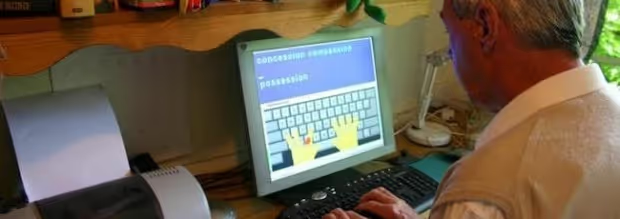
Brian, Retired engineer using TTRS
I worked my whole life as an engineer but I've struggled with severe dyslexia. When I used to do e-mails it was a nightmare, but now, what would take me half an hour I can do in five minutes. It's been two years since I started using the Touch-type Read and Spell course and my reading has improved significantly. In the beginning, one or two modules might have taken me half an hour and I’d try and do that every day. These days I’m much faster and I can do up to ten modules in one sitting. TTRS has given me confidence.

Maria, Doctor and English language learner
I began using the TTRS course after my English literacy level was tested and seemed low. I'm originally from South America and I work as a doctor in the UK. I also have dyslexia. I spent a year doing about 30 minutes of typing each day. When I was tested after using TTRS, my scores revealed that my word reading skills had improved by 22 standard score points! I feel like this is quite an achievement! Before TTRS, I used to type slowly and inaccurately with two-fingers. Now I am faster at the computer, make fewer errors, and write more professionally.
Anna, Adult learner with mild dyslexia
I have mild dyslexia. Unfortunately, there was no help for me when I was younger, so I’ve always just struggled along. I run a guest house and when I write on the computer, it’s easier to cover up errors. In the first few weeks of Touch-type Read and Spell, I didn’t think I was getting much better. Then, when I was typing a letter out, I felt wow, I seem to be typing differently. Typing felt more automatic and I wasn’t overthinking the words and how to spell them, I was just doing it. I was typing faster and my fingers knew where they were going.

Martin, Adult learner with severe dyslexia
I’m fifty years-old and I’m a hairstylist but I can say that I’ve endured a lifetime of struggles because of my dyslexia. It’s so severe that if it weren’t for my computer, I would still be completely illiterate. I was actually looking for different tools to use on my iPad when I discovered Touch-type Read and Spell. I can already say that TTRS is fantastic. I enjoy it and I do it every day. I wish they had had a multi-sensory program like this when I was at school.

Charlotte, Interested in transcription work
Because I’m a single parent, I really like the flexibility of working from home. Right now, I do mainly home crafting - but it doesn’t bring in enough income. I’d like to pursue transcription work in the future, so I know I need strong typing skills for that. Touch-type Read and Spell has been useful for me because it’s helping me with my touch-typing and my dyslexia. In the beginning, I was really slow at typing, but after a few weeks of TTRS, I went up from 25 to 45-50 words per minute.
Jen, Adult learner and homeschooling mom
I’ve never been officially diagnosed with dyslexia, but I’ve struggled with reading and spelling all of my life. One of the things I like most about the Touch-type Read and Spell Course are the subjects. They have technical terms and definitions from science and math that you can practice typing. There’s a section I let my son try and it was really interesting to watch him. He had such a high level of success with the program that I created an account for him -- it's something we can both use!

Alexis, Adult learner with mild dyslexia
I work at a children’s book publisher and I do most of my writing on the computer. Listening to the words in TTRS really helps me. I can hear and see the word, so it’s easier for me to pinpoint whatever little thing I’m doing in my mind that’s not working. For example, I tend to struggle with vowel sounds and I’m always one letter off. TTRS is great because it helps me see these issues - it makes it really clear when I miss a letter. Plus, I like it and I actually look forward to doing it!

Caroline, Adult student working in healthcare
At 27 I’m going back to school for an occupational therapy degree. I’d been working as a care-giver in the healthcare sector and realized this is what I wanted to do. I was assessed for dyslexia when I was 8 and then again at 17. When I first started using the Touch-type Read and Spell program I was terrible. But I’ve noticed an improvement already when I’m typing. I know where the letters are. I’m typing with more confidence and I’m motivated to keep taking modules as I want to get things perfect.

Jennifer, Parent of a child with dysgraphia
My youngest son who is 11 right now has dysgraphia. He’s a very smart child who can write when he’s dictating as his thoughts are free-flowing, but the physical act of writing really frustrates him and gets in the way of his self-expression. I read about how typing might help with the dysgraphia and he started using Touch-type Read and Spell about three or four years ago. Since then, he’s just done wonderfully and that’s why we keep signing up.