



Child-led learning is a term used to describe education programs in which children are responsible for deciding what and/or how to learn. In some cases, it extends to kids being in control of how long they spend on a particular lesson and the methods and materials used for study. Quite often it is undertaken in a homeschool environment or in a private tutoring context.
While this movement typically stands in opposition to a fixed curriculum, some schools offer individual classes or after-hours programs that take a more child-led approach. There are also situations in which giving a child a greater role in deciding how much and what to learn is more appropriate, such as sessions for kids who struggle with learning difficulties.
In a child-led learning environment, a learner might be given free range to engage with material as he or she chooses. This could include doing art, singing or role-playing, instead of completing traditional question and answer worksheets. Alternatively, it may be that parents introduce options and the child is able to choose one that he or she would like to pursue.
In other cases, adults select the topic and lesson but students steer it in a particular direction. Depending on the setting, parents and tutors work to create balance and introduce materials that go along with and support the child’s needs.
Self-directed learning and self-esteem
Not all educators who practice child-led learning interpret it in the same way. Nonetheless, it is based on the idea that children are naturally curious about the world around them. By allowing kids to explore, you encourage them to become life-long learners and to take responsibility for their education.
Instead of satisfying requirements and ticking off boxes, students are given a central role in deciding how they will spend their time. It may make them more aware of their personal interests, strengths and weaknesses. It can also teach them about how they learn best (auditory, visual, kinesthetic).
Exploring the world is a natural activity and when children trust themselves they develop confidence and a more positive self-image. This is particularly important for kids who struggle with specific learning difficulties and may experience discouragement and negative emotions in a traditional classroom setting.
The adult’s role
Just because children are in the lead, it doesn’t mean adults are absent from the equation. In reality, the opposite is true as parents must work harder to provide the right kind of support, including resources, encouragement and the structure students need to make progress and achieve their goals.
They may need to model certain activities or help kids set reasonable targets. It’s also important to break tasks down into smaller steps so children stay motivated and work on one step at a time.
In a room full of students, the teacher becomes more of a moderator instead of an instructor, guiding the activities and keeping everyone together vs. dictating what will happen next.

Tips for making child-led learning fun
Go exploring
Getting outside and delving into nature is a great way to let the child lead the way. Have a walk around and talk about what you can see, smell and hear. Learn about the birds, the plant-life and the history of the places you visit on a daily basis. Movement also helps children who struggle with attention disorders.
Get creative
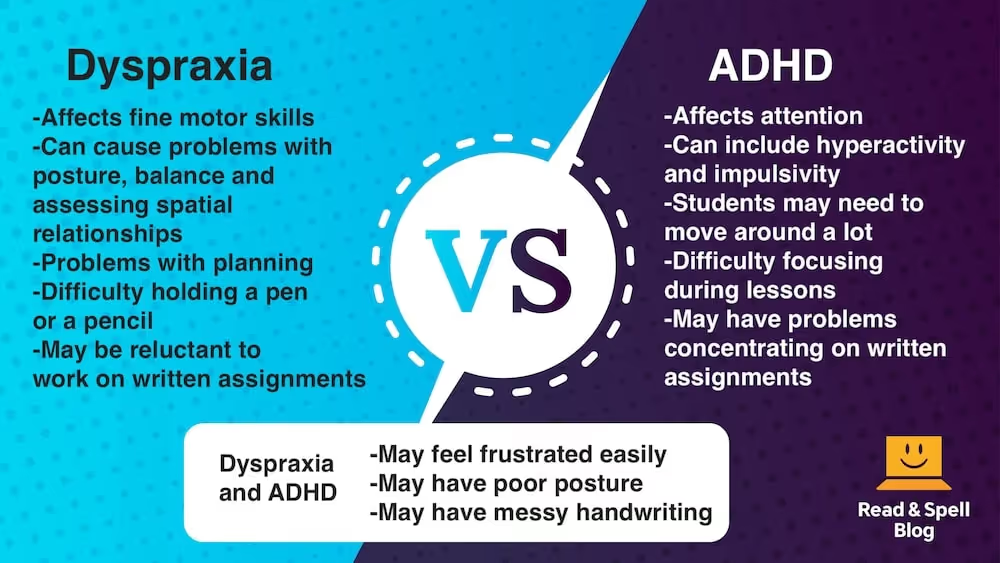
Just because black and white pen and paper activities are standard fare in a classroom, it doesn’t make them superior. If a child wants to take notes in purple, let them. Give them access to colored paper and images and allow them to play around with structure and design in note-taking. Child-led learning encourages experimentation and creative outlets may be particularly welcome by kids who have dyslexia, dysgraphia or dyspraxia.
Involve the senses
Multi-sensory learning is an important part of child-led learning. Babies learn through touch, sight, sound etc. not necessarily through reading and writing. It is possible to provide sensory experiences for older children as well, to enrich learning and create more lasting memories.
Make use of context
Problem solving and discovering things while you are actually engaging with them makes for a more memorable learning experience. If you’re learning about a topic, go to an environment (even an online environment) that will make the lesson more relevant. There’s nothing wrong with taking virtual field-trips!
Encourage role-play
Kids can learn a lot from role-play, a process by which they become a character and explore a topic via experimentation and reflecting on how an individual would behave and speak. Try putting on a few different hats and let your child lead the conversation in new and exciting ways.
Deliver plenty of feedback
Children need plenty of praise and encouragement to keep them motivated. Let them know they are on the right track. Constructive feedback is important too, as long as it doesn’t stifle development or creativity.
Summarize and display progress
Without a fixed curriculum, some parents can feel a bit lost. It helps both kids and their tutors to look at what has been learned, appreciate the achievement and plan the next lesson accordingly. You might try a white-board or keep a journal that logs each lesson.

Additional resources
Child-led learning will not necessarily follow a pen and paper desk-based model. For this reason, you may find it is more frequently used in education programs where children struggle with specific learning difficulties and require a non-traditional approach to literacy skills.
Touch-type Read and Spell (TTRS) is a typing program that teaches spelling, and strengthens sight-reading and decoding skills at the same time. It’s a perfect fit for child-led learning as children who love to work on the computer can work independently and choose to explore subject modules on their favorite topics. TTRS also encourages children to take the lead and set their own pace and challenges, but gives parents and teachers an admin view so they can keep track of progress. It was originally developed to support students with dyslexia and has been successfully used by children with dyspraxia, ASD, dysgraphia, and attention difficulties. Plus, typing is a great addition to any homeschool program!
Do you have any experience with child-led learning to contribute? Join the discussion!