


A good quote can work in the same way as a supportive teacher or coach, providing us with the encouragement we need to strengthen our self-resolve. Quotes can make us feel better about what’s going in our lives. They often teach important life-lessons and are a great way for an individual to share his or her wisdom about an experience.
When it comes to quotes about dyslexia, you’ll find a mix of anecdotes, advice, and words of wisdom. You'll hear from dyslexic individuals discussing their experience at school pre-diagnosis, or in cases where they didn’t receive the help they needed. You'll also hear from people who view dyslexia as their greatest strength.
Teachers may wish to use quotes to inspire students with learning difficulties and raise awareness of dyslexia within the general student population. That's beause they provide opportunities for reflection and thinking about dyslexia in a new way.
What is dyslexia?
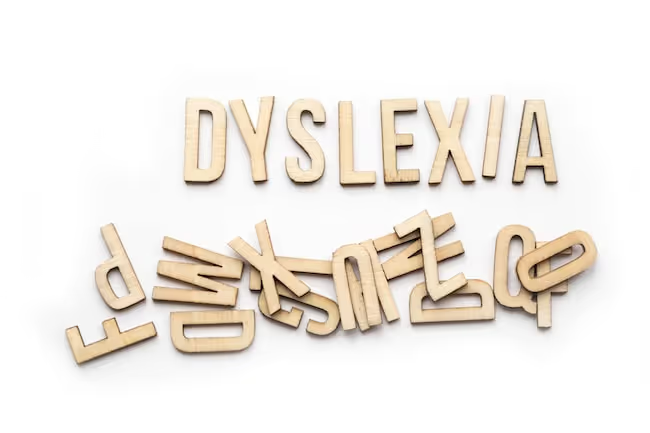
Dyslexia is a specific learning difference that affects reading and spelling ability and can cause children and adults to struggle with literacy skills. It has nothing to do with intelligence and is not a disability, but rather a different way of dealing with language in the brain.
As you will read in this collection of quotes, many adults see dyslexia as their greatest strength and have attributed enhanced creativity and problems solving skills to the unique way in which they process information.
However, for neurodiverse children struggling to develop reading skills, dyslexia can cause a lot of frustration. Dyslexia often interrupts a student’s ability to split words into their component sounds, which makes sounding out words and spelling difficult.
Fortunately, there are coping strategies that can help. That’s why one of the most important steps in addressing dyslexia is ensuring that everyone in the child’s life, from family to educators, is informed, so the right accommodations can be put into place.
Encouragement, motivation and self-esteem
It is important to encourage dyslexic students who may have enjoyed reading as small children but formed negative associations with books at school. School environments can be difficult for all kids but they are often particularly damaging to a dyslexic child who is underperforming.
Tasks like reading aloud or writing during group work can cause embarrassment and feelings of low self-worth. Nonetheless, by choosing the right books and implementing the right classroom accommodations, you can make a big difference in how a child experiences learning. Learn more about encouraging children with learning difficulties in this article.
Strengths associated with dyslexia
Whereas a difficulty can be overcome, a disability describes a lacking ability that remains with you for life. When you see dyslexia as a difference instead of a mental deficit, it is easier to look at the positive aspects it brings.
For example, dyslexic people are often extremely creative individuals who excel at seeing the big picture, finding patterns and bringing together information from different domains. They may be spatially oriented and are often talented artists or musicians. They also tend to be dynamic problem solvers who “think outside of the box.”
9 Quotes about dyslexia
A list of quotes can be a useful tool when you are looking to motivate a dyslexic child. If the learner has already received a diagnosis, then you may want to focus on quotes that talk about the strengths of dyslexia vs. negative school experiences.
Teachers and parents may also wish to spend some time reading about the people who have given these quotes. Often they have dyslexia success stories and are individuals that can serve as role-models for kids who are having a hard time with reading at school.
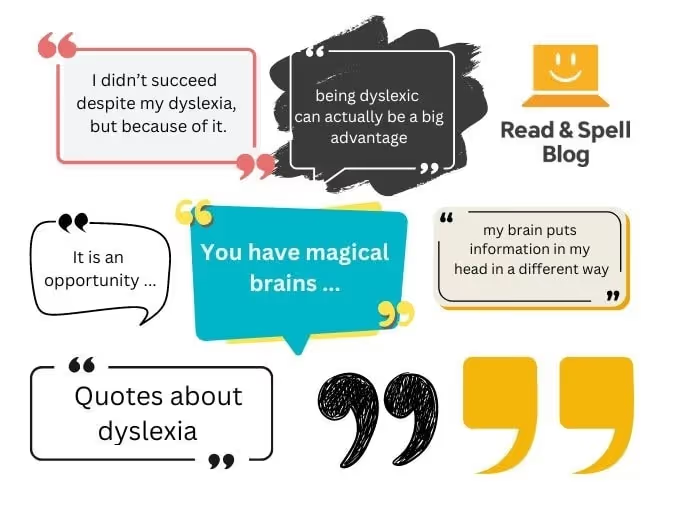
“Dyslexia is not a pigeonhole to say you can’t do anything. It is an opportunity and a possibility to learn differently. You have magical brains, they just process differently. Don’t feel like you should be held back by it.”
-Her Royal Highness Princess Beatrice
Princess Beatrice often speaks to schools about her experience learning to manage her dyslexia. She stresses the importance of focusing on the positive, working at one’s own pace, having a strategy toolkit and studying in a dyslexia-friendly school environment.
“If anyone ever puts you down for having dyslexia, don’t believe them. Being dyslexic can actually be a big advantage, and it has certainly helped me.”
-Richard Branson, Virgin CEO
A successful CEO, Branson had a hard time at school and was often embarrassed by his poor performance on exams. He felt like a failure when it came to reading and writing but didn’t let that hold him back and eventually started his first business—a newspaper for students.
“The advantage of dyslexia is that my brain puts information in my head in a different way.”
-Whoopi Goldberg, Actress and Singer
Goldberg is an Emmy, Grammy, Tony and Oscar Award-winning actress and singer who didn’t realize she was dyslexic until she was an adult. People called her dumb as a child but she didn’t let it keep her down. She also had very supportive parents who encouraged her not to give up.
“Some people read really fast, but you’ll ask them questions about the script and they’ll forget. I take a long time to read a script, but I read it only once. I directed a movie, and I never brought the script to the set.”
-Salma Hayek, Actress
Actress Salma Hayek did not let her dyslexia get in the way of success and even managed to learn a second language, mastering English when she first came to the US.
“I myself cannot spell. Have never been able to. I do not pay attention to spelling and mix letters.”
-Erna Solberg, Prime Minister of Norway
Prime Minister Solberg struggled at school and was finally diagnosed with dyslexia at 16. When she made a spelling mistake on social media Solberg rejected calls that she should hire an editor and instead proudly stated that she was dyslexic and still wanted to write her own posts. Learn more about spelling and dyslexia.
"I had to train myself to focus my attention. I became very visual and learned how to create mental images in order to comprehend what I read.”
-Tom Cruise, Actor
Before becoming an actor, Cruise didn’t do well in school. He struggled with reading and has said he considered himself functionally illiterate when he graduated from high school. Cruise has spoken a lot about his school experience and many quotes discuss how his success came from developing his own approach to study as an adult.

“I used to love reading when I was little, and then it became difficult and I didn’t understand why.”
“Because of my history, it’s hard for me to learn things, so I practiced 20 times as hard.”
-Jewel, Singer
Jewel had to work hard to overcome her dyslexia. These quotes show how important it is to receive a diagnosis early on.
“I didn’t succeed despite my dyslexia, but because of it. It wasn’t my deficit, but my advantage. Although there are neurological trade-offs that require that I work creatively [and] smarter in reading, writing and speaking, I would never wish to be any other way than my awesome self. I love being me, regardless of the early challenges I had faced.”
-Scott Sonnen, Professional Athlete
Sonnen also struggled with visual impairments as a child and is now a successful martial artist who often speaks about his experience with specific learning difficulties.
“One of the greatest struggles for me was that I couldn’t write fast enough for the words, so I would have all these ideas and things that I want to put down on the page and I could never get them down, and when eventually I did, it wasn’t quite as it had been in my mind. It’s still a problem now because even when I’m talking my mind moves faster than the words can come out.”
–Orlando Bloom, Actor
Bloom’s quote discusses a common experience among dyslexic people when it comes to writing. It's one reason why some individuals find touch-typing to be a better approach than handwriting, because muscle memory in the fingers helps them keep up with the pace of their thoughts.
Accommodations for dyslexia
No two individuals with dyslexia will experience the same set or severity of symptoms. The quotes assembled here show just how varied dyslexia can be.
The important take-away for students is that no matter how great the challenge, there are always ways of overcoming it!
The first step might be implementing study strategies for school, like drilling sight words and using mnemonic devices. It’s also important to adjust classroom tasks and practice, to provide the right kind of support.
Touch-type Read and Spell
Touch-Type Read and Spell (TTRS) is a highly structured, multi-sensory, computer-based program that helps kids improve reading and spelling skills through touch-typing lessons. The course takes an Orton-Gillingham phonics-based approach in which users hear a word, see it on the screen and then type the corresponding keys, bringing together auditory, visual and tactile components to reinforce learning.
TTRS is a flexible tool where users learn at their own pace. It was developed to support dyslexic students in acquiring computer and literacy skills and is recommended by the British Dyslexia Association.
Additional References
- arkbolingbrokeacademy.org/news/princess-beatrice-tells-pupils-dyslexia-opportunity
- helpingeverychildtoread.com/index.php/success-stories/famous-dyslexics/actors/item/salma-hayek
- dyslexiahelp.umich.edu/success-stories/tom-cruise
- statvoks.no/forward/goodpractice_erna_no.htm
- understood.org/en/learning-attention-issues/personal-stories/famous-people/14-musicians-with-learning-and-attention-issues#slide-6
- childmind.org/article/orlando-bloom-on-dyslexia/