



Over 25 years ago, the UK government published a report on literacy and numeracy in which they found approximately seven million adults – which works out to be about one in five - were not reading at a level that could be expected of an eleven-year-old child. The report included a target that by 2010 this statistic should be cut in half, lifting approximately 3.5 million adults out of functional illiteracy. Sadly, it's now many years later and we're still not seeing any marked improvement in the numbers.
What does it mean for adults to be functionally illiterate?
Short, uncomplicated writing on familiar topics can be understood, but reading new sources on new topics is likely to cause difficulties. A person who is functionally illiterate might struggle with reading the instructions on a household cleaning product, the words on a bus timetable, a form, or even helping their own children with elementary level homework, not to mention reading them a bedtime story.
If the reading skills needed to complete everyday tasks are not problematic, an individual can still be below the required literacy level to attend a college of further education, or take a focused online learning course to improve their skills. Additionally, many types of employment might be unachievable, even if they are jobs based on manual skills rather than literacy. This is particularly the case for jobs involving regular paperwork or some degree of reading and writing emails to clients.
Struggles with literacy not only impact the UK economy, but on a personal level, they affect quality of life for a significant number of people. A disproportionate number of adults who cannot read are unemployed; a disproportionate number of adults who cannot read live in poverty; a disproportionate number of adults who cannot read end up in prison.
Note, there are also adults who struggle with literacy because they speak English as an additional language - and different ethnic communities show differing levels of mastery of reading and writing in English.

Self-esteem and low confidence in individuals who struggle with literacy
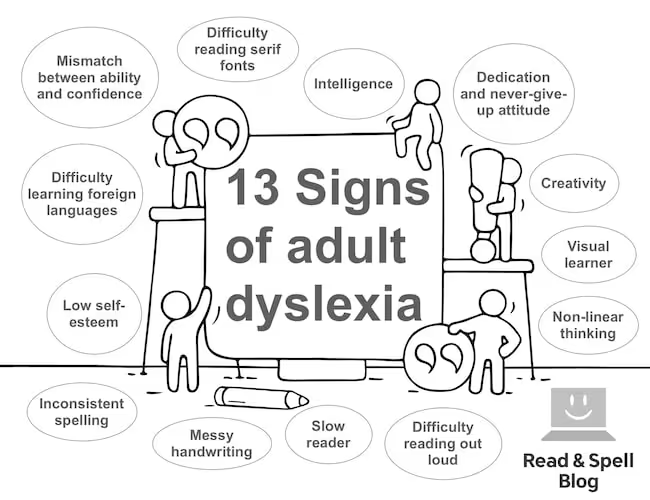
Low self-esteem and a lack of self-confidence are common among men and women who struggle with literacy. These adults may have left school early or simply had negative experiences as a result of being misunderstood or on the receiving end of bad teaching. In some cases, a learning difficulty, including a specific learning difficulty like dyslexia, may have been present but not diagnosed when they were at school - learn more about the signs of adult dyslexia.
A child who saw everyone around them doing well but wasn't able to succeed themselves can easily have internalized feelings of low self-worth. Even as an adult, they may believe they are less intelligent or less skilled than their peers.
Adult learners with undiagnosed specific learning difficulties may seem agitated, stressed, nervous and generally feel quite intimidated about returning to the classroom. Far too many were labeled uncooperative or stupid when in fact they just required more processing time during lessons or a different teaching approach.
Some adults describe this awful, gut-heavy feeling they get when others seem to grasp something so easily but they're somehow destined for failure because the task requires reading, writing, and/or correct spelling.
One teacher provided the example of a mature woman attending his classes for adults with literacy difficulties. She was holding down five jobs, including working as a carer and an office cleaner, all while parenting a grandchild. At the end of one of her lessons, she scored 100% on a literacy module, stood up and shouted “I’ve got 100%. I’m somebody!” Here is an example of an adult with tremendous coping skills whose feelings of self-worth were very much so connected to her reading and spelling abilities.
Considering strategies and resources for teaching the adult student
Adult students who find the courage to improve their literacy skills can have a range of motivations. Tapping into these may well be the key to success, especially if a teacher can respond to them in bringing together different resources for adult appropriate learning programs. Many adults will find children's books humiliating, even if they're at the right reading and spelling level. However, an adult who wants to improve their literacy skills to help their own children with schoolwork, or read them a bedtime story, may find books for children are completely appropriate and the ideal resource!
An overall effective strategy which applies to all teaching is to find out what your student wants to achieve, make expectations clear from the beginning and then focus on the learning. There’s an elegant clarity to the approach of goal setting, information giving, coaching and providing feedback. If you don’t know where you are going, how will you know when you get there?
It’s important to recognize too that literacy tutors may a have a hard time taking on students with an undiagnosed learning difficulty. Your first step may be to get a sense of your students' current skills and look at potential testing so they can get recognition and targeted support. Learn more about spelling strategies for adults.
Learning tools
Computer assisted learning can be especially helpful when it comes to providing the repetition needed for literacy skills to develop. Computers never get bored repeating the same information over and over and can allow the learner to work entirely at his or her own pace. They can supplement your teaching and offer an adult student the practice he or she needs with reading and spelling.

Touch-type Read and Spell
The Touch-type Read and Spell platform develops and improves reading, writing, spelling and computer skills by teaching touch-typing in a unique, “dyslexia friendly” way. The first module of the course names and covers the finger positions of the vowels and from then on the course takes a whole word approach. The core curriculum can improve an adult learner's confidence as it offers an opportunity to build literacy skills without the embarrassment of an overtly phonics-based method.
Learning the skill of touch-typing can also open up new career opportunities for adults as it helps with basic computer skills -- and it doesn’t have to take that long to master the skill!
Do you have any tips or strategies to share on helping adults develop basic literacy skills? Send us an email or leave a comment on social media and join the discussion!
Resources:
Improving Literacy and Numeracy: A Fresh Start. The report of the working group chaired by Sir Claus Moser, 1999.