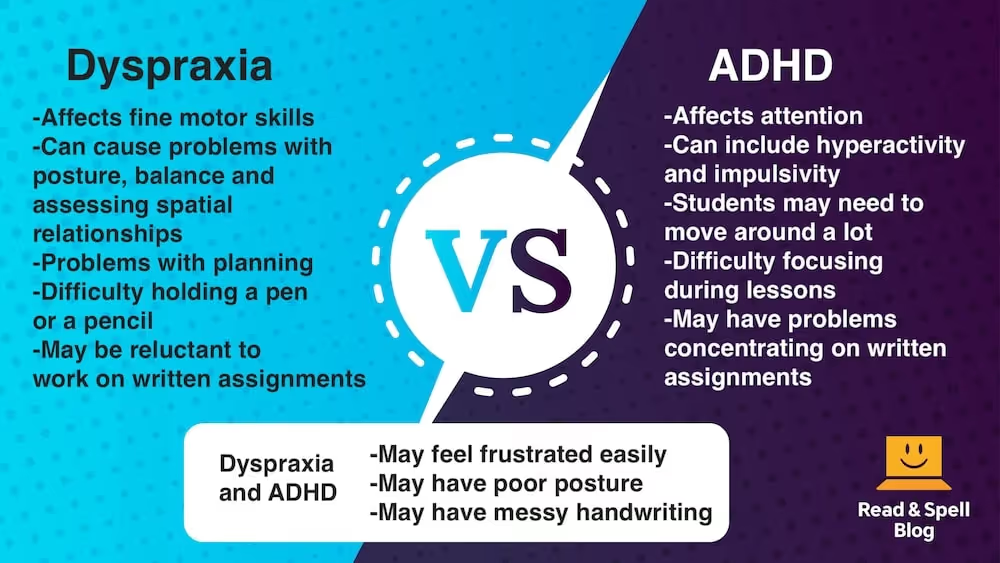




Attention deficit hyperactivity disorder (ADHD) is a specific learning difficulty typified by short attention span, lack of concentration and in the case of ADHD presentations that include hyperactivity, poor control of impulses. A student with hyperactivity and impulsivity might be restless, uncooperative or even disruptive in class. They can be the child who doesn’t sit still and struggles to listen. Because of their high activity level, children with this ADHD presentation can try to solve problems physically and their behavior may lead to problems with other students.
ADHD without hyperactivity, formerly known as attention deficit disorder (ADD), is now included under the ADHD umbrella and identified as ADHD with a primarily inattentive presentation. These students may struggle to focus but are often harder to spot in the classroom. They can be quiet and calm, and may seem to be paying attention to a lesson. Nonetheless, problems can show up when they are called on to answer a question or struggle to complete homework and other assignments.
Using the right teaching strategies can help students with different ADHD presentations focus their attention, strengthen their self-esteem, and have more agency in learning. If you haven't tried a strength-finding activity, it might be a great way to start any new teaching program. Children with ADHD often receive a lot of negative attention so looking at their strengths first and understanding how their learning difficulty might actually benefit them, can help them get on board with new approaches. You can learn more about ADHD strengths and get some ideas on lesson plans in this article.
ADHD and ADD: What’s in a name?
You'll find sources use the terms ADHD and ADD in different ways. This is due to several factors. In the UK, ADD is still in use, whereas in the US the preferred terminology is inattentive presentation of ADHD. Prior to the late 1980s, ADD was the main term in both countries, so older sources may still refer to ADD instead of ADHD and then specify with or without hyperactivity. To make things even more confusing, in addition to ADHD and ADD, you may also see ADD/ADHD, AD/HD and AD(H)D.
While ADHD is classed as a specific learning difficulty, it's important to remember that learning difficulties are just a different way of processing in the brain and are not related to the student’s intelligence or potential for learning. The key to reaching potential lies in finding and applying the right strategies.
Recognizing a child with ADHD
ADHD symptoms can be mild to severe but for illustrative purposes, we’ll describe behaviors at the extreme end of the scale. In class, a student with ADHD might not be able to sit or stand still. They can be impulsive and have a low boredom threshold and low tolerance for frustration. They might be easily distracted, always looking up and around, and frequently fidgeting with fingers, pencils and other objects. They can demonstrate negative or oppositional behavior. They might not follow the rules – not necessarily because they don't want to but because they just don't hear them. A student with ADHD who hasn't listened properly might blurt out an inappropriate response to a question. They may not wait their turn. They might have trouble with social skills and this can result in strained interactions with peers. They may not always be able to control themselves.
Students with ADHD might be able to decode in reading activities, but can struggle to focus on the material they're reading, so comprehension can be poor. They may be disorganized, lose their possessions and homework, and generally not be prepared for lessons. They can also have poor fine motor skills, and produce messy written work. While symptoms in adults tend to diminish with age, early identification and intervention are important so that children with ADHD can develop effective coping strategies.

Introducing strategies
To address behavior in the classroom, a first step is to ask a child what they are experiencing and how they feel about school and/or what they're learning. It may be that the child doesn’t perceive there is a problem with their behavior, so tell them about your own perceptions. “These are the things I see in your behavior.....we are going to work on them. We’re a team. I’m on your side and I can help.” You might explain that there are a lot of strategies you can try together. In this way, if a strategy doesn’t work, they won’t feel that they're failing, just that they haven't found the right one(s) yet.
When setting goals, and developing a plan, identify a problem then consider the different possible solutions: “What would happen if you did this? Or that? What would the consequences be?” With each goal, reinforce the strategy: “This is the plan. This is how are we going to get there. If you follow the plan, you’ll get where you need to be." Do this regularly, and the child will eventually start developing their own plans.
The aim is to empower a child with ADHD and help him or her feel in control. As with all strategies, there’s no point in setting them up if they are not used consistently and/or the child doesn’t know what they are for. It also helps if parents and teachers can work together to agree on goals. Be consistent with them, as well as the language used to discuss them.
8 Tips for teaching students with ADHD
1. Provide students with structure.
It helps to give children with ADHD plenty of structure and direction. They may learn from discovery, but unstructured learning can also be hard for them when there are too many options.
2. Break tasks into steps.
Give assignments one at a time and break tasks down into small manageable chunks so each part is clear to the student. Shorten tasks or steps to coincide with the child’s attention span. Allow extra time.
3. Monitor time management.
Consistently monitor time management, which can be an on-going problem for students with ADHD. Give a timeline and have clear expectations of a standard of work. React positively as they complete steps. A child usually knows whether or not they're on track, and over time, they learn to monitor their own work.
4. Keep feedback positive.
Teachers and parents might be inspired to say “Don’t do that” quite often. These can be children who receive a lot of feedback for negative behavior. Be quick to say “It was great the way you did that” and to immediately praise positive behavior. Everyone listens to praise.
5. Ignore minor inappropriate behavior.
Try not to address every incident of acting out and to approach outbursts with humor. Give the student a chance to recognize, accept and laugh off their behavior as well. Helping a child with ADHD maintain a positive self-image is key. You can learn more about ADHD and self-esteem in this article.

6. Stand close by.
A teacher doesn’t always have to teach from the front of the classroom. If you have a child who is bouncing around in their seat, they are probably not learning. When a child is struggling to sit still, sometimes just standing near them can help calm them down.
7. Know your students.
Get to know your students. Every child with ADHD is unique and each one will have different strengths, as well as symptoms they struggle more with. Try to give them opportunities to show their strengths and to mix in activities that they actually enjoy doing, for example educational computer games.
8. Allow physical activity breaks.
Exercise can be the key to helping a student with ADHD focus. One teacher shared that if their student indicated he simply couldn’t sit still in his seat for another second, and she responded that she agreed, the student would be allowed to leave the classroom, do some jumping jacks in the hall, and then return. You can also try to build tactile learning into lessons or let students get up and walk around regularly, which can benefit all students in the class.
9. Teach social skills.
Modeling is very important as is working with a partner, which can teach good social behavior and cooperation in learning.

Allow technology in the classroom
Allow the use of computers where appropriate. Touch-type Read and Spell is a typing platform that can be highly effective for students with ADHD. It's carefully structured, and teaches typing in a unique way using a whole word approach. This means children learn to spell while they learn to type. It is appropriate for seven-year-olds and up – once the hands are mature enough to sit comfortably on a keyboard.
Discover typing for students with ADHD
The course embodies what is good practice for a child with ADHD. Tasks are broken into small chunks, presented in a multi-sensory way with immediate positive feedback of success.
Short modules are delivered at the child’s chosen pace, with a clear understanding of the expected standard of work, and with the opportunity to redo work as appropriate. Self-esteem is enhanced and the student feels in control of their own learning. Being able to touch-type also manages the messy handwriting children with ADHD may have, and gives them a skill for life.
References
- Weiss, L.G. (2005). WISC-IV clinical use and interpretation scientist-practitioner perspectives (1st ed.). Amsterdam: Elsevier Academic Press. p. 237.
- Parrillo, V.N. (2008). Encyclopedia of Social Problems. SAGE. p. 63.
- Cowen, P., Harrison, P., Burns, T. (2012). Shorter Oxford Textbook of Psychiatry (6th ed.). Oxford University Press. p. 546.