


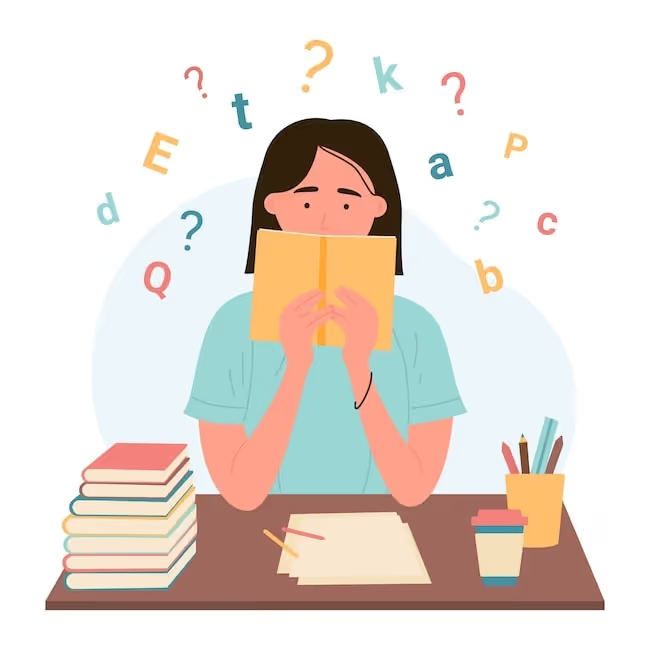
Everyone has difficulty with spelling from time to time. You might make a mistake when you use a word infrequently, or have trouble reporting a word’s spelling verbally when you’re put on the spot. These are common issues for a few reasons. One is that spelling is something we usually do in writing - delivering this information in another modality can be awkward. Two, spelling is information that we store in the brain as procedural knowledge.
This means it becomes automatic only after a person builds up extensive contact through repeat exposure to a word in reading and writing. You might have certain words you always mix up because you never learned the correct spelling, or because you wrote them incorrectly and now can’t tell the right from the wrong version. But some people struggle with spelling in a very different way.
For example, dyslexic individuals may put a word’s letters in the wrong order, miss out on a letter, or even add one that doesn’t belong. They often have difficulty spelling consistently, and can get a word right one day and not the next. This doesn’t mean they are “stupid” or “lazy,” it just means there’s something interrupting the encoding process by which words are split into their component sounds and those sounds are then mapped onto English letters.
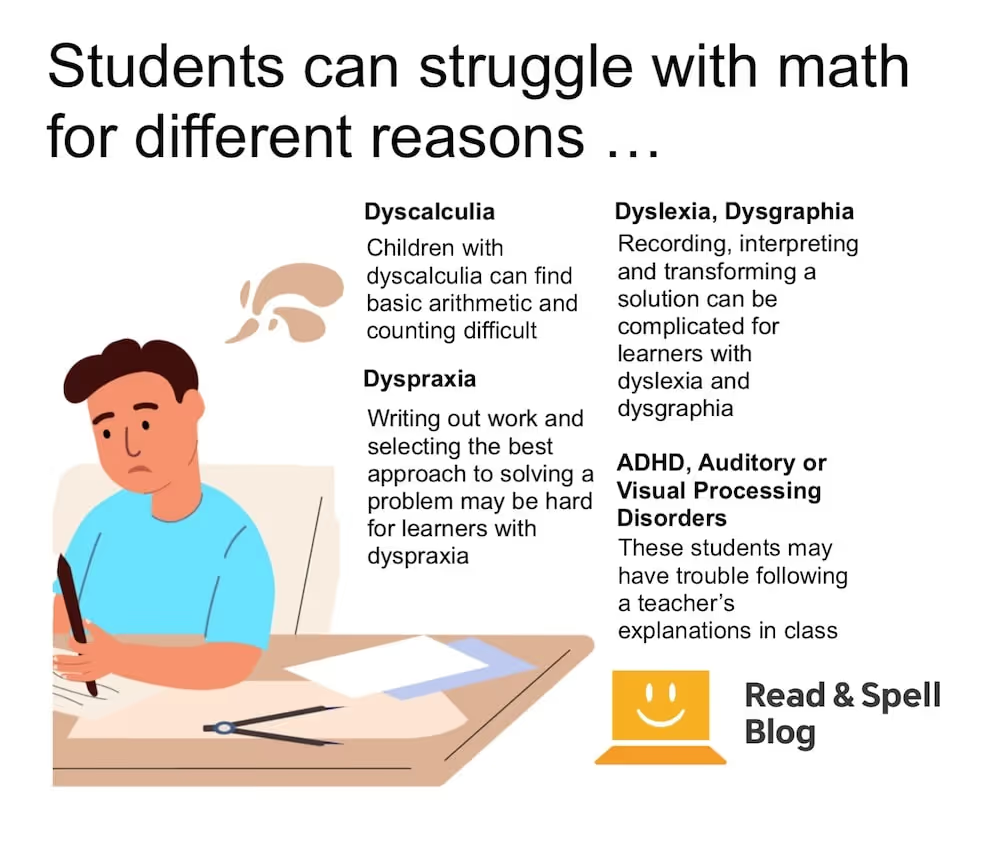
Dyslexia is not the only issue that can affect spelling ability. Some people with attention difficulties have a hard time, particularly if they write in bursts and struggle to focus when proofreading their work. Spelling is a surface level feature of writing and it may not be as important as getting the ideas down on paper before they’re gone. When you have a hearing impairment it makes it harder to hear the sounds in words, which translates to lower spelling ability.
Individuals with motor skills difficulties, such as dyspraxia, can find spelling challenging as well. This is because they are distracted by the physical pain they feel when writing by hand, or because the dyspraxia co-presents with dyslexia. The more you read, the more exposure you get to language and the greater your chances of spelling a word correctly. But mature learners who struggle with reading can also struggle with spelling because they’re not getting the same type and/or amount of input.
Fortunately, there are accommodations and strategies that can help children and adults improve their skills and regain confidence when undertaking writing projects in the classroom and workplace.
Learn more in these posts: Spelling for adults, Spelling strategies for dyslexia, Developing spelling skills
What kind of spelling mistakes are common?
Spelling a word how it sounds
In theory, all languages should have a one to one mapping system in which every sound is represented by just one letter. In this way you’d be able to spell and make sense of everything you read, and there would be no need for spelling rules at all. While this does happen in some languages like German and Spanish, it is definitely not the case for English. English actually has far more sounds than letters (44 to 26) so one letter or letter combination can be used to represent multiple sounds – which is confusing. English also has lots of inherited spellings that no longer reflect today’s pronunciation of a word (think about the silent k in knight).
Note these types of errors are extremely common in children who are just learning how to read and write. This is because encoding a word, or using the sounds to figure out the letters, is an important first step in learning how to spell it. You just need to be able to add in some additional information about which English letter combinations commonly represent which sounds, and to know which words are exceptions to the rule.
Mixing up words that only differ by a handful of letters
Our brain does its best to sort and store language effectively but it can get confused when processing words that have close orthographic, phonological, or semantic neighbors. In other words, language that looks alike, sounds alike, or means something similar is easier to mix up. This is particularly true if two words only differ by one letter and/or if they are commonly found in the same context.
Getting a word ending wrong
In English, words are built out of a stem and then have bits added on to their start and end in order to change the meaning or serve some grammatical function. It’s less common to make a mistake with a word's stem than it is to put the wrong ending on it (or leave the ending off in the case of silent letters). The endings -able and –ible are a notoriously tricky pair as are –ent and –ant because a similar sounding vowel sound is the only way to tell them apart. That’s one reason why studying common English prefixes and suffixes may make you a better speller.
Struggling with proper nouns and words of foreign origin
Your brain draws its own conclusions about which sounds and letter combinations are acceptable in English based on commonalities between all of the words in your vocabulary. When a new proper noun or a word of foreign origin comes along your brain may initially reject the way it sounds and is spelled if it doesn’t conform to English norms. This may make it harder to remember the word and is one reason why learning a foreign language is so difficult - our brains actually resist the process until we manage to get enough vocabulary in that the language creates its own system. Discover more about studying languages as a dyslexic learner.
Adding or leaving out vowels
Standard English has a lot of spoken vowel sounds compared to other languages. In fact, we have 24 (compare that to Arabic which has a mere 5). We also have a lot of words that come from French, thanks to the Norman Conquest of England back in the 1100s. Written French vowel combinations are notoriously long and complicated, though they usually just stand for one sound. This means that it is easy to get mixed up when looking for the precise combination of letters to represent the sound you are hearing.
Read more about dealing with challenging spelling words and the hardest words to spell in English.
What can you do to become a stronger speller?
- Use a computer. Thankfully we have computers with spell-checkers and autocomplete today. This helps everyone improve their spelling by catching little mistakes and allowing us to focus on the content of our message vs. the words we are using. Using a spell-checker is in no way a form of being lazy - actually seeing your mistake alongside the correct version of a word can help you learn it!
- Try repetition drills. The more you write a word, the better your brain becomes at processing it and the more automatized its spelling will be. Sit down and write a word out multiple times. The physical act of doing this either by hand or typing on the computer will translate the word’s spelling into muscle memory, which turns it into procedural knowledge. This is even more effective if you learn it via touch-typing. Learn more about how touch-typing can help individuals with dyslexia and other difficulties become better spellers.
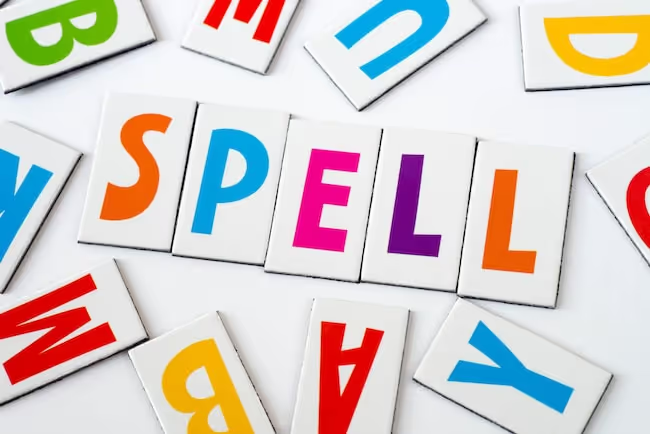
- Get out the brightly colored markers. Doing something creative and multi-sensory that involves spelling will help to encode a word in memory. To visually stimulate your short-term memory, you might write each letter in a different color or draw an illustration to go alongside the word (this is easier for concrete nouns than abstract ones!)
- Trace your finger in the sand. Have you ever seen those meditative sand pits that people put on their desks? These can be used to help with spelling too! Try tracing the letter shapes and writing the word out in sand, use a stick to trace it in the dirt or even wave your finger around to write letters in the air. It’s a multi-sensory technique that adds a kinesthetic element to help with learning.
- Spell out loud. While it’s awkward at first some people are audio learners and hearing their own voice recite a word’s spelling helps them to remember it. Just think of it as a spelling bee made for one or try it in the shower if you have a list you don’t mind getting wet.
- Read more. Exposure to written input can leave a lasting impression on your brain. Were you to read the same word written ten times in a paragraph you’d have a much better chance of spelling it correctly. This is a particularly effective technique if you’re having a hard time spelling words from a particular subject area or domain. Look for some industry specific magazine articles and extract important vocabulary afterwards for repetition drills. See if it gives your skills a boost!
- Engage with the words. Think about them, use them, write them, research their origins. The more cognitive energy you spend processing a word, the more likely you are to remember its spelling.
For parents who want more ideas on helping their kids at home with spelling, try this post. If you’re a teacher looking for some fresh ideas on how to teach spelling, we have an article for you.
How do you know if you need help?
Are you generally insecure about your spelling skills? Have you ever decided not to participate in an activity, keep in touch with friends and family, or apply for a job or education program because of your lack of confidence in your spelling? The emotional component to spelling difficulties can be severe. It can cause you to lose confidence in your abilities and to suffer from low self-esteem. You may wrongly think you are unintelligent or a bad writer.
Moreover, you may have been told you are lazy or not putting enough effort in, when in reality it’s just down to how your brain processes language. That’s why it’s worth looking into specific learning differences that could be to blame.
If you know what is causing your issue, you can begin to find solutions in the form of strategies and accommodations. Note that many individuals with undiagnosed dyslexia develop coping skills to help them get by. You may have struggled with spelling from a very young age but it can be the common and high frequency words like here, they, and of that are most problematic.
That’s because it’s harder to apply memory strategies to learning them. Also note that people with dyslexia may have a hard time spotting errors when proofreading their own writing. Homonyms (or words that sound the same but are spelled differently, such as bear and bare) might be particularly challenging, as can be words of foreign origin, and people and place names.
Have a look at our articles on adult dyslexia and undiagnosed learning differences in adults to learn more. There are online screening tests available for many learning differences. These come in the form of brief surveys that will ask you to perform certain tasks and answer multiple choice questions then tell you if it is a possibility that you are struggling with a learning difference. Based on the results of the screening you may or may not want to pursue more in-depth and diagnostic testing. Learn more about how testing for dyslexia works.
Touch-type Read and Spell
The Touch-type Read and Spell course is a typing program that was originally designed to help individuals with dyslexia improve their literacy skills by learning to type in a unique, multi-sensory way that also strengthens reading and spelling skills. However, it can work for anyone who struggles with spelling regardless of whether or not you have a learning difference. The method uses a specific order and set of words. You see them, you hear them and you type them.
Through repetition, this approach helps your brain store the words in long term memory. Learning to touch-type also bypasses language difficulties in the brain by turning the spelling into a series of keystrokes, so you can spell in the same way as you would enter your pin code or dial a phone number.
Taking an online course is a great way to boost your confidence. TTRS divides the lessons into short, easy to complete modules so you can do a little at a time and build momentum gradually, even with a busy schedule. Plus, you’re graded on your accuracy, not your speed, so there’s no added pressure. You’ll also be able to repeat modules as many times as you need until you’re ready to move on.
Touch-type Read and Spell gives children and adults a chance to boost their spelling and reading in a fun way, by learning to type.