



While most words are relatively easy to learn, every individual will encounter challenging spelling words that they frequently misspell. Making spelling mistakes is frustrating for students and can lead to low self-esteem for learners who may be labeled as lazy and penalized by losing points on written work.
For adults, having poor spelling skills can cause them to miss out on career opportunities and lose face in front of friends and family. It’s important to understand that spelling skills have nothing to do with intelligence and that there are plenty of strategies that can help. If spelling becomes a persistent problem, there may also be an undiagnosed learning difficulty to blame.
How spelling works
Spelling is one of those skills that children learn when they are first beginning to read and write. This is because reading requires decoding, or sounding out words by mapping sounds to the letters and letter combinations they contain.
Unfortunately, certain languages, including English, do not have a 1:1 correspondence of sounds to letters. There are thus multiple ways to spell the same sound (consider fish and pharmacy). Challenging spelling words often contain phonemes that use a less common grapheme mapping convention due to foreign origin or antiquated spelling.
Here are some additional factors that help determine how hard a word is to spell:
- Frequency
Lower frequency words that are rarely encountered are often more challenging. The more you see a word day-to-day, the easier it will be to spell. That’s because every time you are exposed to a word you notice its spelling, even if you're not consciously focusing on it. - Word Origin
English has a tendency to allow new words into the language and contains many terms in common usage that are actually of foreign origin. There are words that come from French, Latin, Greek, Russian and even Arabic. - Silent Letters
For children and English language learners, silent letters which appear in consonant and vowel combinations but are not actually pronounced can make spelling very difficult. In general, the more familiar one becomes with English spelling conventions, the less distracting silent letters will be. - Number of Characters
The longer a word is, the more letters an individual has to produce in sequence and the greater the chance of error. That’s why short words tend to be easier to spell, particularly when they contain common consonant and vowel clusters or familiar prefixes and suffixes. - Individual Differences
The difficulty of a word is in some part decided by each individual based on how meaningful the term is to them, how often they encounter it and use it, and which other words they know that might have similar spellings. Having learning difficulties can also increase the challenge a particular word poses for individuals.
Is spelling important?
Having good spelling skills may seem less important today because of the amount of words we produce using a computer, smartphone or tablet. These devices have auto-complete, auto-correct and spell-check functions.
If you are using a word processor and misspell a word it will either provide you with the correct version, or in the case of entries it does not recognize, scan a dictionary and suggest alternative words that you might have been trying for.
A smartphone has a smaller screen-based keyboard that makes it easier for big fingers to accidentally type the wrong letter. Phone and tablet based auto-correct functions thus allow for a greater margin of error that is more to do with the proximity of letters than misspellings that come from incorrect sound/letter mapping.
Yet for spelling correction tools to work, the user still has to be able to approximate some of the letters.
Tips for mastering hard spelling words
- Develop a mnemonic device or rhyme. Sometimes our brains find it easier to store information if we use a trick that combines sounds, images and meaning. If you always struggle with reversing a pair of letters, remembering a silent letter or knowing whether it is a double letter or not, you can find a funny way of explaining the spelling. For example, dessert (as opposed to desert) has two s’s because it is so delicious you want to go back for more.
- Use them in writing. Set yourself a challenge such as writing ten sentences using the word you are struggling with. Come up with different contexts and try to be creative in the task. This will expend more cognitive energy than simply writing out the word multiple times, which helps your brain remember it! It will also expand your productive vocabulary at the same time. Learn more about improving writing skills.
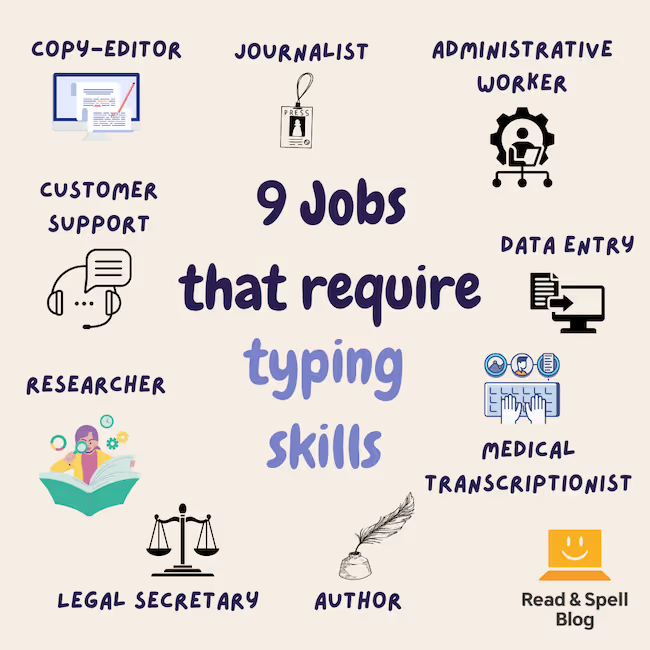
- Learn how to type them. Writing by hand is one thing but touch-typing a word brings in an extra element -- muscle memory. Did you know your hands can help you remember how to spell a word? If someone asked you to deliver the spelling out loud you might not be able to but if you were allowed to type it your fingers might automatically produce the sequence of letters, provided you were familiar with this word.
- Research them. If you look up a word’s meaning in the dictionary or spend five minutes searching for its origins then two things will happen. One is that you will be dedicating a certain amount of time focusing your attention on the term, which is much more powerful than simply attempting to memorize an item on a list. Secondly, you will be exposed to the term many times as you read about it. This helps your brain store a mental image, which it can access when you are struggling.
- Draw or illustrate words. In the same way as repeat exposure can reinforce the spelling of a challenging word, creating a particularly salient image also helps. Visual learners might try pen and marker to design a word using bright colors or enlarged text. Adding additional images or creating a picture story for the word can also be helpful for people with dyslexia.
- Spell them out loud. Rehearsing the spelling of a word out loud means your ears get used to hearing the sequence of letters required. You might be able to better catch errors because the letters you’ve said don’t sound correct. This is also a great strategy when you're practicing for a spelling test and it is exactly the kind of exercise spelling bee contestants go through.
Learning difficulties, attention disorders and more
Individuals who struggle with learning difficulties, attention disorders and other conditions that affect language processing often find that the most challenging terms to spell are among the most common words in the English language.
In particular, service words such as articles and prepositions, pose considerable difficulty as they are not amenable to mnemonics and do not have any distinctive features or concrete meanings to help them stick. In these cases it might be helpful to “over-learn” the words either through writing them out multiple times or typing them, in order to automatize their spelling.
Dyslexia
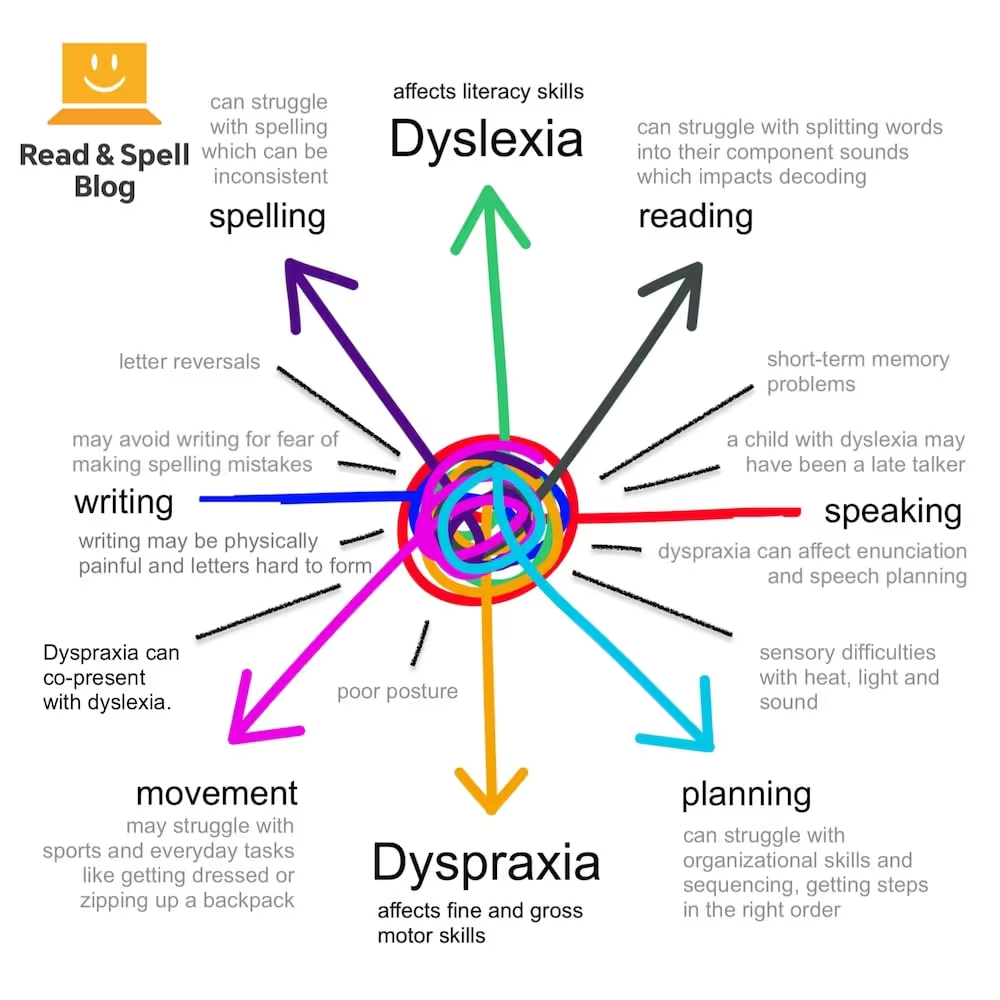
Dyslexia can look different in everyone but often affects a person’s ability to notice the individual sounds that make up words. If you can’t hear all of the sounds it will inevitably be much harder to spell words. Drilling phonics and reinforcing sound letter mapping through dictation exercises can help.
Discover a typing program that helps with spelling
Dyspraxia/ Dysgraphia
Dyspraxia and dysgraphia have to do with the skills required for writing and can make it difficult and painful for individuals to write by hand. The less a word is produced in writing, the harder it is to get the spelling correct, as it is not automatized. Touch-typing is a great solution in both cases—learn more in these articles on handwriting difficulties and dyspraxia.
ADD/ ADHD
Both Attention Deficit Disorder and Attention Deficit Hyperactive Disorder make it hard for an individual to focus their attention. Without being able to concentrate on a task, such as learning the spelling of a word or reading a paragraph that uses certain words, children miss out on the benefits of repeat exposure. They also tend not to have the patience required to revise and copy-edit their own work. This means they have a harder time noticing when they have made common spelling errors. Try these articles on ADD and ADHD for suggested strategies that can help.
Slow Processing
Individuals with slow processing may need longer to understand task constraints and get started. Just following instructions and manipulating ideas can be so mentally taxing that depending on the length of the piece of writing, there might be no cognitive energy left to focus on more surface level features, such as spelling.
Spelling for English as an Additional Language Learners (EALs)
There is so much to do when it comes to learning a language, from acquiring vocabulary to mastering grammar and written language conventions. Spelling sometimes falls by the wayside. Learners may also struggle with spelling due to the irregular nature of spelling in English.
There is more than one way to spell the same sound and there are more than enough exceptions to most English spelling rules to frustrate native and non-native speakers alike. Nonetheless, spelling skills count because making a lot of spelling mistakes can lead native speakers to judge a language learner and form incorrect opinions about the quality and level of his or her language skills.
Learn more about improving writing skills in English and helping EALs.
Spelling for adults
Adults may find lacking spelling skills can get in the way of job success and education goals. They may also be a source of embarrassment that can cause individuals to put off getting help. Learn more, including how touch-typing can be a great way of acquiring a new skill and improve your spelling at the same time.