



Writing is one of the most important skills English as a second language learners must master, particularly for students and working professionals. That’s because unlike in speaking exercises, when you write you leave a lasting record of your language.
Mistakes in spelling, grammar and word choice are immediately evident. And while literacy skills are not a reflection of intelligence or knowledge, poor writing can cause a student to receive lower marks, even if they know a lot about the subject of the assignment. In a professional context, people may judge you as lazy or untrustworthy if you send poorly written emails full of mistakes.
They are also likely to assume your spoken ability in English is quite low, though this may or may not be the case. That’s why it is important to improve writing skills in English before they prevent you from reaching your full potential at school or in the workplace.
Fortunately, the more often you write, the easier it will be to access the English you are looking for and express yourself accurately and fluently. Researchers know that if you are a strong writer in your first language, chances are you will also be a strong writer in English.
That’s because strategy use transfers. However, you can always learn to be more strategic as a writer and improve your skills by signing up for a class.
A composition course, even one aimed at native speakers, will help you improve the way you react to different texts, organize your ideas and bring together vocabulary, grammar and tone to enhance your writing. Spelling and fluency, when it comes to the actual process of putting words on paper, can be improved by taking an online course.
Keep in mind that you can’t learn how to write overnight. It’s a process and the more you write and receive feedback on your written work, the stronger you will become.

How writing works
Reading is a receptive skill that requires an individual to make meaning from the language input to which they are exposed. In writing, learners must actually create meaning and produce their own language. That’s why writing is so hard, even for native speakers.
It begins with translating ideas into language and moving them around so the reader can follow your train of thought. Next, comes the process of revising to find the most precise and convincing wording that renders ideas clearly and concisely. Finally, you need to make sure there are no grammar, spelling or formatting errors which will distract the reader from what you are saying.

Top tips to improve English writing skills
- Start with a mind-map. A great way to set the stage for a piece of writing is by brainstorming ideas related to your topic and activating all of the English you will need to express yourself. Try creating a mind-map in which you write down any prior knowledge you have on the subject in bullet points and specify facts or opinions you would like to include. You may also choose to make a list of English vocabulary words that will help you articulate your thoughts.
- Use an outline. A blank page can be intimidating, even for the most seasoned writers. Give yourself something to work with by laying out the structure of your piece in advance. Leave placeholders for an introduction, several paragraphs that provide support for your thesis, and a conclusion, then use your mind-map to fill in the details.
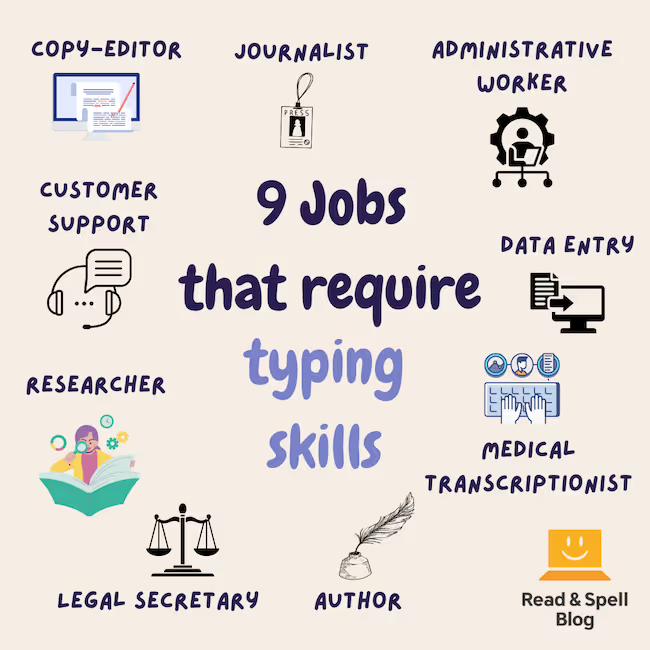
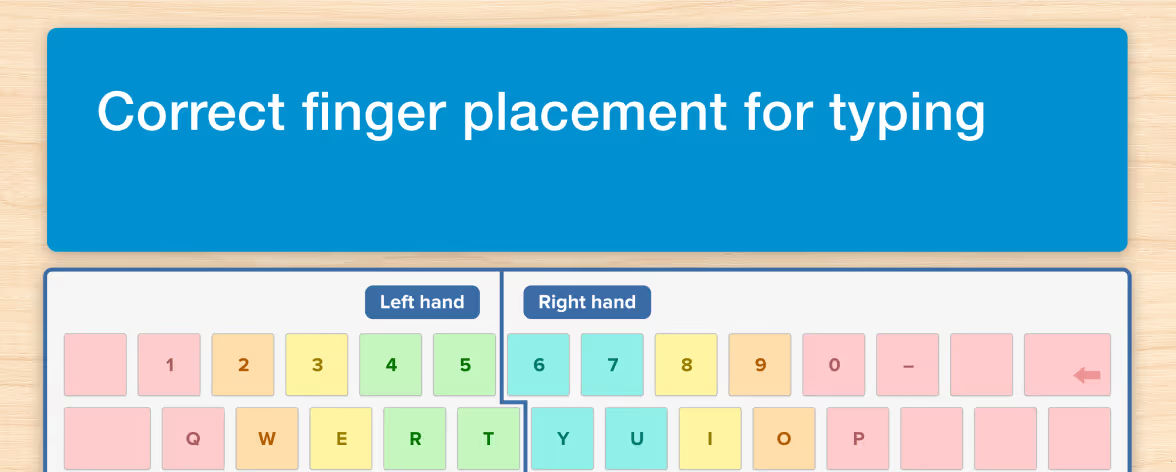
- Learn how to type. Did you know that we think a lot faster than we write? Translating ideas into language can be slow and cumbersome if you are handwriting or hunting for individual letters, one key at a time. You can lose your train of thought and or experience frustration with the mechanics of writing. But you can automatize the process and help your thoughts flow freely through your fingertips and onto the screen by learning how to touch-type. You’ll not only be faster, but more accurate too.
- Revise, revise and revise some more. Writing is a process that involves crafting a sentence then going back to re-read what comes before. You want to be sure your ideas make sense in a particular order and that you’ve used a variety of different vocabulary words and phrases to express yourself. When you write on a computer, you can use the same document for your mind-map, outline and initial draft. Being able to copy, paste and delete means revisions are a lot easier to make. Continue to write and revise until you are happy with your draft.
- Have a native-speaker proofread your work. Everyone makes mistakes in writing. This is because when you’ve been focused on a text for so long, it becomes hard to see the errors. Leave your work for a day or two before you come back to it to proofread. It’s also helpful to ask an English speaker to take a look as they are likely to catch awkward phrasing and may even be able to provide you with some more native-like solutions when it comes to re-wording and presenting your ideas. Depending on the length of your piece, you can sign up for a language exchange and help someone with their writing in your native language at the same time.
- Use spelling and grammar checks. Some learners may feel that relying on automatic spelling and grammar checks is cheating because it prevents you from catching your own errors and allows you to be less accurate. However, these checks can help call attention to problems with your English grammar and/or spelling skills. Use the content that they bring up as a learning experience and decide on how to revise each error by weighing their suggestions. You’ll be surprised at how much you learn.
- Build your productive vocabulary. Most English language learners have a larger receptive vocabulary than a productive one. This means you may understand a word when you see it but it won’t necessarily show up in your writing. Purposefully using words you have recently learned is one way to increase your productive vocabulary. When you use a word in your writing, it makes it more likely it will be available the next time you sit down to compose a sentence. Another strategy is to use a thesaurus to look up alternatives to the words you have chosen. Just be sure you don’t pepper your text with awkward word-choices that don’t fit the context or your original phrasing.
- Spend more time reading in English. Good writers tend to be avid readers. The more you read in English, the more you are exposed to different ways of expressing ideas. The grammatical structures and style of the writer will eventually start to show up in your own writing and you may learn some new vocabulary at the same time.
- Familiarize yourself with different text types. Not all writing assignments require the same kind of English. A factual article for the newspaper, an email to a potential employer and an essay for a literature class will all necessitate a unique format and different elements. You can improve your writing by familiarizing yourself with a diverse range of text types. For example, read the newspaper, look up sample essays and make your way through an English novel or two.
4 Tips for English teachers
- Help students overcome their fear of a blank page by starting off your lesson with an activity that helps them generate language and ideas for their writing. This is a top down strategy that will allow them to activate prior knowledge and personal experiences that relate to the topic.
- Research shows that strategy use transfers from a learner’s first to second language after they have reached a certain ability level. For those learners who are not strong writers in their first language, introduce and model writing strategies.
- Be on the lookout for learning difficulties. You may think spelling mistakes and poorly organized text are a result of lacking English skills but there may be another issue such as dyslexia, dyspraxia or dysgraphia that is causing the problem. The earlier a learning difficulty is diagnosed, the sooner a student can learn strategies to overcome it.
- Go over the difference between written and spoken English. Every language learner eventually discovers that not everything we say in conversation is acceptable in written form. Beginner learners might need you to call their attention to some common examples (such as writing going to instead of gonna).
Learn to type
Taking a touch-typing course like Touch-type Read and Spell's can be a great way for an English language learner to improve his or her writing skills.
Not only does touch-typing provide a more automatized way of expressing thoughts in English, but the process of learning the keys can involve dictation exercises which reinforce phonics and spelling. As English is a notoriously difficult language to spell, this can be important in building confidence in writing and facilitating sight-reading at the same time.
Touch-type Read and Spell takes a modular and multi-sensory approach and is also a solution for English students who struggle with learning difficulties, such as dyslexia.
Discover literacy-based typing
Learn more about helping English language learners in the classroom.
Do you have any tips on improving writing skills? Send us an email and join the discussion!