



Motivation to learn correlates with success at school. That's why many parents and teachers are concerned with helping students become more motivated in the classroom. This may mean using recognition and rewards to encourage behaviour that’s conducive to learning.
However, extrinsic motivators alone don’t always do the trick. Teachers who make lessons interesting to kids and help learners get excited about school can foster a lifelong love of learning and encourage students to overcome obstacles and find success.
The two most discussed types of motivation are intrinsic and extrinsic. With intrinsic, motivation to learn comes from within.
It could be that learners are curious, a lesson is fun, the topic is interesting and engaging, or the task provides them with an opportunity to demonstrate their strengths. When a child possesses this kind of motivation, he or she is more likely to be motivated when learning occurs outside of the school environment.
Extrinsic motivation is when teachers or parents introduce an outside force to encourage kids to learn. This could be in the form of a reward, such as earning free time, a sticker, or a piece of candy. It may also be framed via negative consequences, such as when a student cannot go to recess and play with their friends unless they finish classwork first.
While avoiding negative consequences can motivate students in the presence of their teacher, it doesn’t inspire the kind of motivation kids need to continue learning outside of the classroom. It’s also a lot more fun to do something because you love it vs. to avoid punishment.
Moreover, recent research on the overjustification effect has suggested that relying too much on extrinsic motivation can actually discourage kids who were previously intrinsically motivated.
For example, students who played an educational game because they enjoyed it, started to equate play with the reward they received and were no longer interested in the game when the prize was taken away.

Tips for motivating students
- Make learning fun. Not every lesson is fun, but teachers can always find a way to put a cool spin on a task. For example, instead of doing a math problem on the board, bring in some props such as Legos or building blocks and add a tactile aspect to the learning. For literacy skills development, play hangman or host a mini spelling bee competition. Create posters that celebrate students’ favorite books or have students spell out words by lying on the ground in different formations and taking pictures to put up around the classroom.
- Break tasks into steps. Once you get going, it’s easier to keep up your momentum and stay motivated to finish a task. Create a class calendar and set mini-challenges, milestones and steps on the path to achievement. This also helps learners focus on the future instead of just the here and now. Researchers have shown that a learner’s conception of time can be crucial in helping them find the motivation to pursue long-term rewards vs. instant gratification.
- Provide plenty of positive feedback. It’s important to focus on the positives and recognize students for their successes vs. what they need to work on. Constructive criticism is important, just make sure it is balanced and learners receive more positive attention than negative. Recognizing kids for skills they are good at helps them build self-esteem and confidence and maintain motivation.
- Treat students as equals. Instead of wielding your power as an adult and telling a kid they must learn something because it’s in the curriculum or will result in negative consequences if they don’t, explain why it’s important to learn and show them how they might be able to do something new or cool in the future if they are successful.
- Create opportunities for success. When students do well on a task they are more motivated to keep up their success. Teachers can help make achievement more attainable by reducing the complexity of tasks, breaking them into smaller, more manageable steps, and giving learners plenty of time to complete each part at a pace that is right for them.
- Recognize learners. You might give out stickers, stars or simply recognize students in front of the class for their success. Praise delivered before an audience of peers creates a memory of success, which can inspire motivation for years to come.
- Introduce role models. A great way to get students to be more intrinsically motivated is to introduce role models who inspire kids to work harder and achieve their dreams. It may be showing a documentary about a 14-year-old girl who mastered the science and math skills she needed to sail around the world, or holding a Q-A session with a parent who has an interesting career. If teachers draw a connection between school lessons now and success later on, they can make even the most mundane tasks more fun.
- Be positive. Kids pick up on the attitude of adults around them. When teachers are positive and excited about learning, their students will be motivated too.
- Have them write journal entries. Not only does keeping a personal journey encourage writing skills development but it helps learners reflect on who they are, what they like and what they are good at. The more kids get to know themselves, the easier it is for them to become intrinsically motivated in tasks that relate to their strengths and interests. As a bonus, teachers can use the content of the entries to inspire class assignments on various topics.
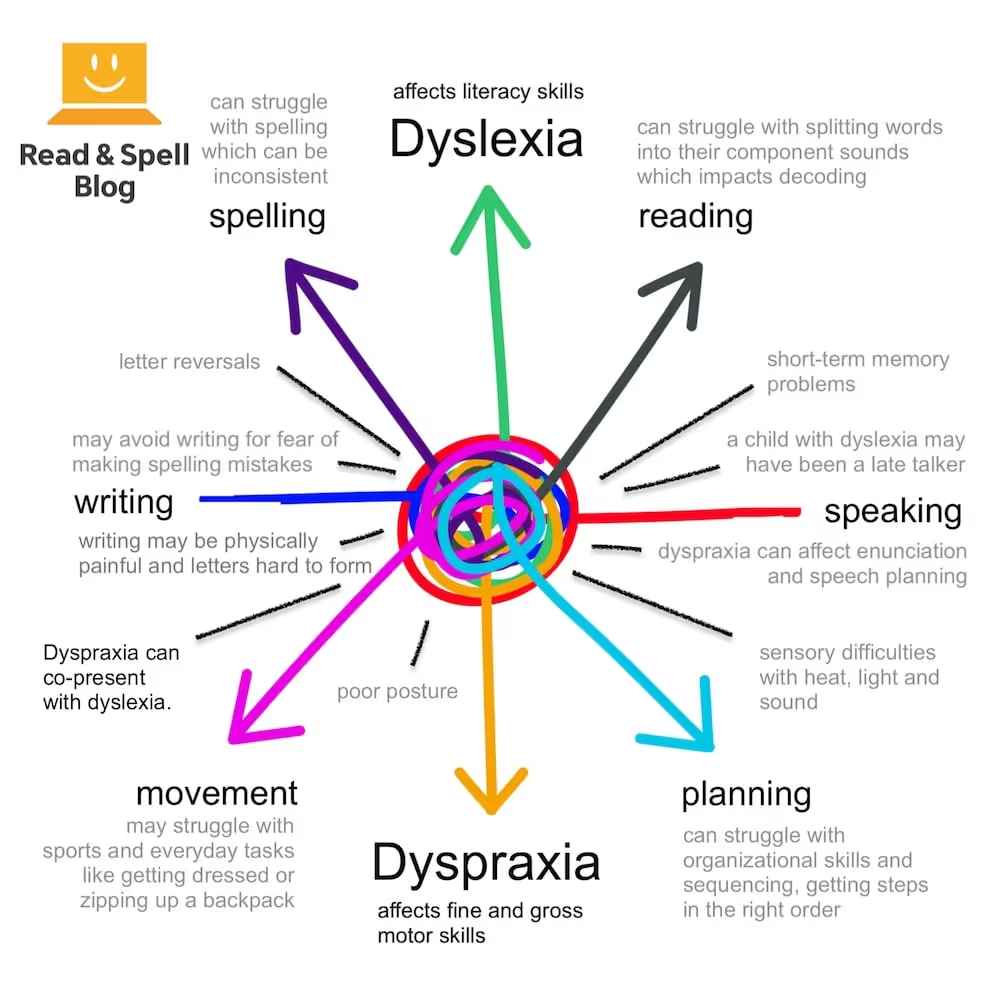
- Pair physical activity with classroom study. Depending on your class, you may be able to provide rewards such as doing jumping jacks or cartwheels after a certain task has been completed. Bringing physical activity in to break up a lesson can help kids use up the extra energy that makes it hard for them to sit still and focus their attention. This may be particularly useful for kids with ADHD and dyspraxia.
- Know your facts. Think about what kids find interesting and dig up some facts to help them get excited about a particular topic. The same subject can be far more intriguing depending on how you present it.
- Tell them stories. An interesting story can grab your students’ attention and engage learners straight away. It could be a personal anecdote, a history lesson or even a made-up tale. Tell a story and get your class to ask questions before jumping into the content of a lesson which will provide them with the answers. Curiosity is the intrinsic motivator kids need to discover more about the world around them.

Students with learning difficulties
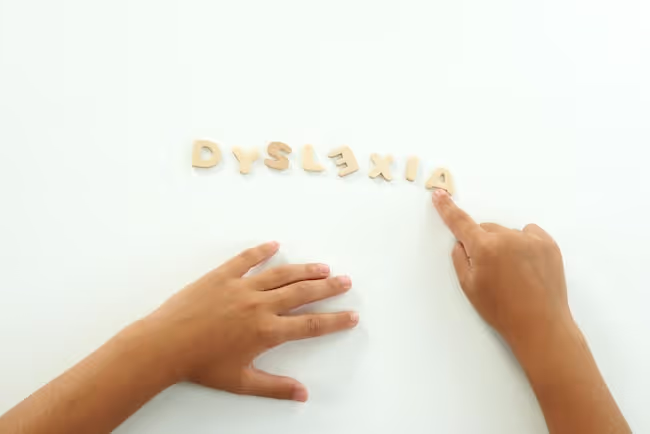
Often students who struggle with learning difficulties, particularly in cases where a diagnosis was made late in the game, have trouble finding motivation to complete assignments.
This may be due to the frustration they experience because of the learning difficulty coupled with the negative associations they have formed after not being successful in the classroom. Teachers can help these kids by learning more about the learning difficulty and then adjusting task requirements to ensure every student has an opportunity to be successful.
Provide plenty of encouragement and positive feedback and consider using technology and strategy instruction to assist the student in overcoming the challenges they face and achieving their full potential in the classroom.
Motivation and English Language Learners (ELL)
When it comes to students who are English as a Second Language Learners, researchers tend to discuss motivation using the terms instrumental and integrative. Being instrumentally motivated to learn English is similar to having extrinsic motivation.
It involves wanting to learn a language in order to gain something, such as to pass an exam or please parents by getting accepted into a good school. However, this is not the type of motivation that most correlates with success in language learning. Rather, having integrative motivation or the desire to integrate with the people and culture that speak the language you are learning is a better indicator of fluency and achievement down the line.
Getting students to be excited about English language culture, in addition to literacy skills, grammar and spelling, is thus fundamental for teachers of ELL students. It’s also helpful to pair them up with native speaking students to ensure they make English speaking friends in the classroom. Learn more about teaching ELLs.

Motivation to learn vs. self-efficacy
If motivation is about why you are learning, self-efficacy is the “how” that sums up your approach. Both are key factors in student achievement.
Consider that some highly motivated students can still do poorly if they lack self-efficacy. Self-efficacy is the ability to take a greater task and break it into smaller, more manageable steps. It helps learners reduce frustration and work more effectively and efficiently, as well as benefiting young-adults who are struggling with learning difficulties.
That’s because mastering a new skill can easily overwhelm a child. By changing the scope of their attention and reinforcing a one step at a time approach, teachers coach students on how to take control of their learning and progress through a task at a pace that is right for them.
Plus, success begets success and doing well helps students approach the next step with renewed energy and motivation to learn.
The Touch-type Read and Spell program takes a self-directed approach to learning touch typing, a skill that helps students develop stronger writing, reading and spelling skills. The course is divided into independent modules which can be repeated as many times as necessary until the student feels comfortable with the material.
Discover literacy-based typing
As they learn to complete one module at a time, there is plenty of positive feedback to keep kids motivated. This builds self-esteem and self-confidence and is particularly useful for those learners who aren’t used to being successful in the classroom. Students may also become more self-efficacious in their approach to other tasks.