


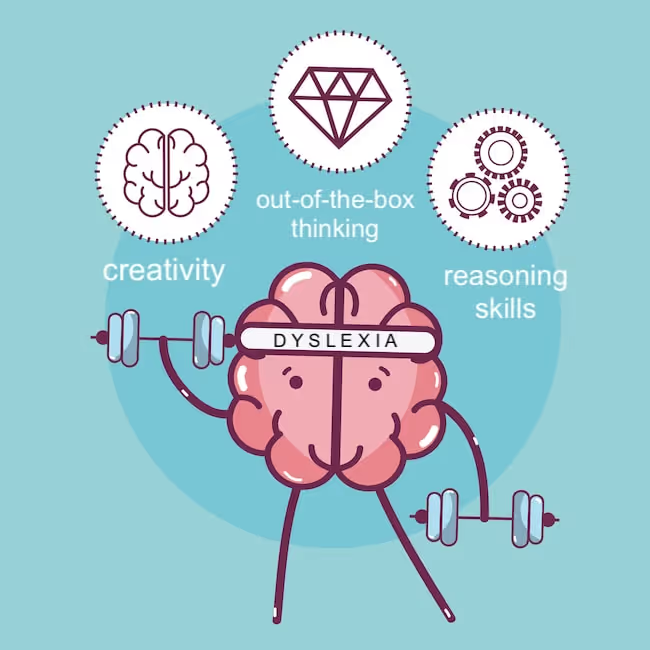
When people hear the word dyslexia, they often think of reading and spelling difficulties. However, this narrow view overlooks the broader context. Dyslexia isn’t just about challenges - it’s about differences, and with those differences come strengths. Individuals with dyslexia often exhibit exceptional abilities in creative thinking, spatial reasoning, empathy, and more. These strengths aren’t just side notes; they’re central to how dyslexic people think, problem-solve, and succeed.
In fact, some of the greatest strengths associated with dyslexia come down to the unique way in which the dyslexic brain processes stimuli, including language. For example, many individuals with dyslexia are right-brain dominant. The right and left hemispheres of the brain are organized in a slightly different way. On the right, cells are more evenly distributed (versus in clusters). This means connections have to cross larger distances, which helps dyslexics with big-picture thinking, pattern spotting, and taking a more open and creative approach to problem-solving.
Many dyslexic individuals also consider themselves holistic rather than linear thinkers. While memorizing facts may not be their strong suit, children and adults with dyslexia can have the ability to integrate personal experiences with acquired knowledge, to generate new ideas. They can make great team players as well, and be extremely creative students who are artistically gifted and have an intuitive sense of spatial organization. That's because visual thinking and spatial reasoning are both associated with right-brain thinking.
Flipping the narrative on learning differences
Let’s explore seven powerful strengths that dyslexic thinkers frequently bring to the table.
Creative thinking and innovation
People with dyslexia often excel at divergent thinking, generating new ideas, imagining possibilities, and solving problems in original ways. They’re the innovators, the artists, the idea people. Think Roald Dahl, Paloma Faith, or Jamie Oliver - all dyslexic and all creative forces in their fields.
Visual-spatial reasoning
A strong right-brain orientation often gives many individuals with dyslexia a knack for visual processing. They excel at understanding how objects relate in space, mentally rotating images, and perceiving the “big picture” in diagrams, layouts, and designs. This can lead to strengths in architecture, art, mechanics, and STEM.
Pattern recognition
Because dyslexic brains often form broad connections, they can identify patterns others miss across data, images, or abstract concepts. This ability to see the forest instead of getting lost in the trees is valuable in strategy, science, and big-picture planning.
Emotional intelligence and empathy
Many people with dyslexia are tuned in to the emotions of others. Perhaps shaped by early challenges, they often develop sensitivity, intuition, and empathy, qualities that can help in leadership, teaching, therapy, and teamwork.
Resilience and grit
Overcoming learning barriers builds persistence. Individuals with dyslexia often develop a tough inner drive and the ability to bounce back from failure. This “grit” is a strength in any environment, especially one that requires long-term focus and adaptability.
Verbal communication skills
Although reading and spelling can be challenging, many individuals with dyslexia are excellent verbal communicators. They may shine in storytelling, public speaking, and discussion-based learning. When they feel confident and supported, their ideas come to life.
Big-picture thinking
Individuals with dyslexia are often holistic learners who absorb and integrate information in a broad, comprehensive manner. This makes them good at systems thinking, understanding how moving parts connect, and ideal for roles that require strategy and vision.
Dyslexia isn't just a challenge - it can be a competitive edge.
Strength finding activities for dyslexic individuals
A great way to encourage people with dyslexia is to help them recognize and celebrate their strengths.
- Make a list. To start with, have the child, teenager, or adult list their strengths. This could be verbally or in writing. They might find it difficult to talk it through. Ask them to recall memories in which they felt proud and try to identify the qualities or actions that underpinned these emotions. Sometimes, the hardest part is finding a name to give the strength that helped them achieve success.
- Paint a picture. If they are a gifted visual thinker, start with images. Ask them to find or draw a few pictures that represent moments when they've felt successful. For each image, try to label it with an associated strength. Having the person explain the image to you gives them a chance to put their thoughts into words, allowing them to find an appropriate way to identify their strengths.
- Fill out a survey. A dyslexic student may need some help reading a small-print or text-heavy survey, but going through a list of strengths and choosing the ones that apply can be an excellent way to compensate for a short list. It's easy to overlook strengths if you've never considered them as skills to begin with!
- Choose a role model. Look at someone else who is dyslexic or neurodivergent, such as a famous celebrity, to see what has helped them achieve success. Discuss any traits or abilities that most stand out and try to identify strengths that you have in common.
- Get specific. If you find someone has listed very general strengths, such as "good at sports," try to get them to be more specific. Which aspects of their game make them so good? Is it their speed and fitness or also their visual reasoning skills and ability to assess the basketball court and expertly judge distances? If they say "I'm good at talking to people," this could break down into more than one strength, such as emotional reasoning, verbal communication skills, and empathy skills. Once you explore more strengths, the list will get longer, which is great for self-esteem and confidence-building.
- Make connections. In the same way that some learners list general strengths, other individuals with dyslexia start with very specific strengths. Help them see how their skills can cluster together and lead to new talents which they have yet to discover. This is an especially helpful activity for individuals with dyslexia who are seeking guidance for future academic and career pursuits.
Next, try some of these confidence building tips!
Famous dyslexic thinkers
Many celebrated individuals credit their dyslexia for their success:
- Richard Branson (Entrepreneur)
- Steven Spielberg (Director)
- Agatha Christie (Author)
- Tom Cruise (Actor)
- Whoopi Goldberg (Entertainer)
They didn’t succeed despite their dyslexia; they succeeded because of it!

What is dyslexia?
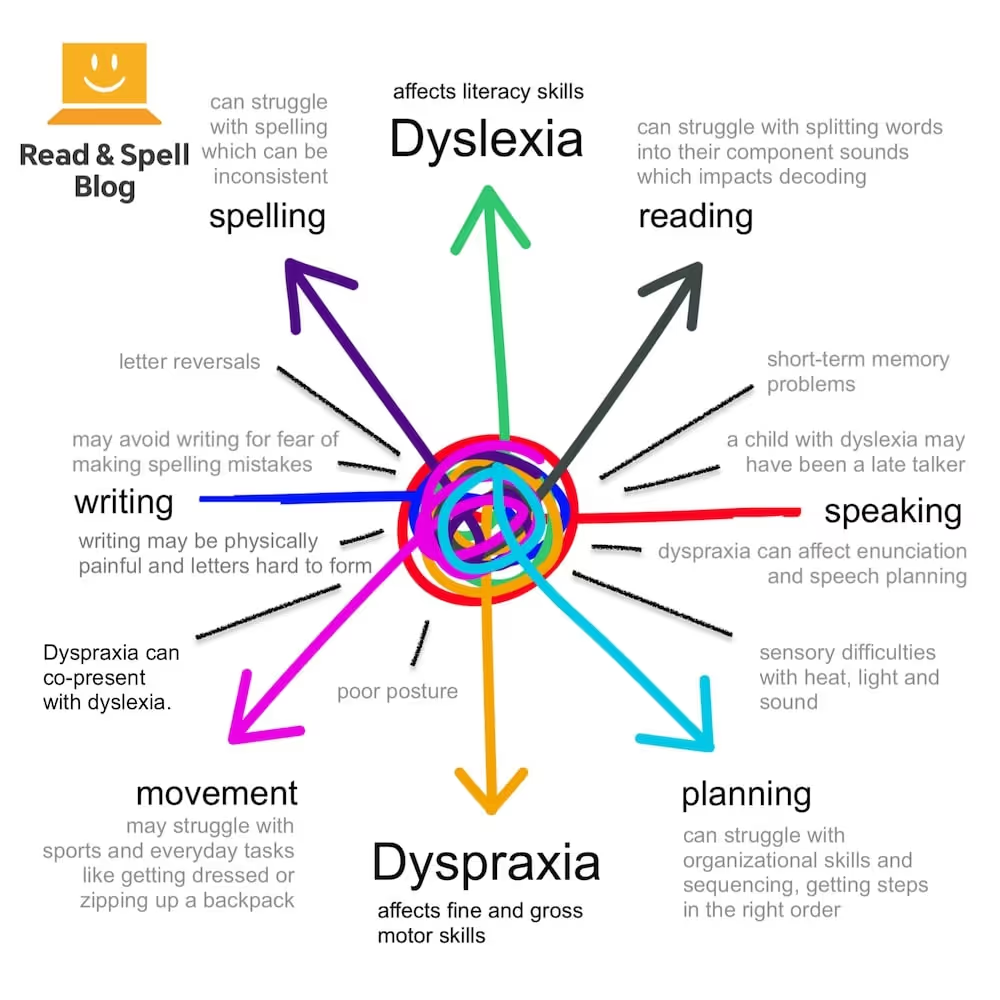
Dyslexia is a learning difficulty that can affect reading and spelling skills. Dyslexia has nothing to do with intelligence; it simply describes a different kind of cognitive processing. Dyslexia can present in different ways, but many people struggle with phonological dyslexia which makes it difficult to split words into their component sounds.
TIP: Did you know that some groups today advocate for more neutral language to describe dyslexia, such as calling it a specific learning difference instead of a difficulty or disability?
No two people with dyslexia are the same
The severity and symptoms of dyslexia vary, as do its strengths. Some individuals may exhibit exceptional creativity but struggle with numerical work, while others may possess strong logical reasoning skills but have poor spelling. Acknowledging these differences and helping students find their strengths is key to success.
Supporting students with dyslexia
There are plenty of successful dyslexics, from Steven Spielberg to Tom Cruise, who talk about their childhood with mixed emotions. They may have struggled at school and felt they needed to hide their dyslexia from their parents or teachers. Worse, they were sometimes labelled as "stupid" and "lazy" or told they weren’t "trying hard enough."
It is crucial for teachers and parents to be aware of the signs of dyslexia. Even after it has been diagnosed, dyslexia can still make reading a daily struggle for people who don’t have the proper coping strategies in place, and can undermine confidence, no matter how talented an individual is.
If they are struggling with reading, dyslexic learners can quickly fall behind their peers at school. Over time, poor performance and frustration can lead to a negative attitude toward learning and activities involving reading and writing. It can cause people to lose confidence in their abilities and develop an unhealthy sense of self-worth. That's why it's so important to recognize the symptoms of dyslexia early on and to get students the support they need.
Strategies for dyslexic learners
Having teachers or instructors who are dyslexia aware and can incorporate and promote multi-sensory, dyslexia friendly-teaching and learning strategies, can make a big difference.
Many students with dyslexia will benefit from spelling strategies, including creating mnemonics devices to remember hard-to-learn words. Mastering touch-typing is another strategy that can help. Typing transforms a word's spelling into a sequence of key-strokes and muscle movements, which may be easier for someone with dyslexia to remember.
Learn more about keyboarding and why it helps people who struggle with dyslexia.