



Dyscalculia is a learning difficulty that affects an individual’s ability to do basic arithmetic such as addition, subtraction, multiplication and division. Adults with dyscalculia often take longer when working with numbers and may be more prone to making mistakes in calculations.
They can also experience higher levels of anxiety and frustration. It may be harder for adults with dyscalculia to learn and recall math facts, such as times tables.
Estimation skills can also be affected. Dyscalculia is not a reflection of low intelligence, nor does it mean an adult will not be successful working through higher order mathematical reasoning. However, many people with dyscalculia believe they are simply bad at math.
Because math is involved in various areas of the school curriculum, from chemistry to physics, as children these individuals may have felt they were less capable of achieving success in the classroom. Over time these feelings can develop into low self-confidence and low self-esteem.
Adults with poor math skills are more likely to suffer in terms of career opportunities and management of personal finances. There’s additionally a greater chance they are struggling with more than one learning difficulty, such as dyslexia, or an attention disorder like ADHD.
That’s why it’s important for individuals with undiagnosed dyscalculia to get a diagnosis, so they can gain access to the help and support they need to be successful. As the British Dyslexia Association has commented “We can’t ignore dyscalculia anymore!”
For some adults, just acknowledging the presence of a learning difficulty can make a big difference in boosting self-esteem. That’s because it takes away some of the shame associated with poor performance.
When dyscalculia is officially diagnosed, it can also provide an adult access to appropriate accommodations, such as calculators for use on standardized exams. These exams may have previously been serving as gatekeepers which prevented an individual from pursuing their higher education goals or career promotions.
For others, a diagnosis of dyscalculia means an opportunity to learn new coping strategies for dealing with numbers, which can lead to a significant improvement in quality of life.
For example, there are apps that can help with daily management of finances, tracking spending automatically and making it easier to plan for, schedule, and pay regular bills. Some adults with dyscalculia discover a diagnosis motivates them to begin an online or classroom-based course to build up their skills, in preparation for a more fulfilling career.
Math skills are integral in management and sales positions, cashier and clerical work, nursing, pharmaceutical science, and dentistry, and even in trades like landscaping, plumbing, electrical and construction work.
Learn more about undiagnosed learning difficulties in adults.
What is dyscalculia?
According to some researchers, there is less genetic evidence available for dyscalculia than for other learning difficulties, like dyslexia, but studies have shown it does run in families (1). The most characteristic trait is experiencing difficulties when dealing with numbers, including counting and doing arithmetic.
Other early signs of dyscalculia are a reliance on counting with fingers when peers have ceased the practice (this is due to difficulty learning math facts) and trouble estimating numbers.
For example, dyscalculia can impair your ability to look at a group of objects and understand approximately how many there are, or to grasp the difference between the relative size of two things. It may make it hard to work with fractions and graphs. In day to day life, someone with dyscalculia may struggle with any activity where numbers are involved, from telling time and paying for something at the cash register, to adding up points in a board game or following a sports game.
It’s important to distinguish between children and adults who are struggling with dyscalculia and those individuals who are experiencing math anxiety. According to the Centre for Neuroscience in Education, math anxiety typically entails poor performance in math in both ordinary life and academic situations (2).
An individual with anxiety might do fewer problems in a set than he or she is capable of or draw a blank and not be able to begin a problem he or she is normally able to do. Math anxiety can affect anyone and is not related to the underlying skill set of the individual, though many people with dyscalculia do experience high levels of anxiety because of the added stress they feel when working with numbers.
It’s also worth noting that visual processing disorders can affect an individual’s ability to read charts and graphs and perform the spatial reasoning tasks involved in some areas of mathematics, such as geometry. Dyscalculia in children and adults can be diagnosed by a cognitive psychologist or a learning specialist. As no two individuals are alike, a series of diagnostic tests will provide more information about the strengths and weakness of every individual.
When dyslexia and/or ADHD are also present
It is not uncommon for dyscalculia and dyslexia to co-present. The same is true for ADHD, with some estimates projecting 11% of learners who struggle with dyscalculia also have an attention disorder (3).
Because phonological dyslexia impacts language use, including reading skills, it can make math word problems particularly challenging for learners with dyslexia to negotiate. Short term memory difficulties in students with dyslexia have also been found to affect recall of math facts (4).
Individuals with visual dyslexia may additionally struggle when it comes to reversing numbers, understanding how different sides in an equation or parts of a fraction relate to each other, and/or reading graphs. As a type of visual processing disorder, visual dyslexia can have a severe impact on a student’s skills in geometry and physics, subjects that require spatial reasoning.
Learn more about dyscalculia and dyslexia.
Going back to school
Math skills can be gatekeepers. It’s not uncommon for adults to have struggled in high school and found failing math grades kept them from earning a high school diploma. It may also have been that poor performance on the math section of a standardized test put a halt to higher education dreams.
In working life, many trades include assessment measures where math problems feature strongly. Going back to school, whether through an adult basic skills program or a targeted course to prepare for work certifications, can help adults with poor math skills build their skills and regain confidence.
School can be a very different experience once the dyscalculia has been acknowledged and appropriate accommodations and strategy training put in place. If you’re an adult who is considering returning to school, you might also consider an online course or some apps to get you ready and excited for your program.

5 Tips for adult learners
- Let your teacher know you have dyscalculia. Teachers may be able to extend time limits for in-class quizzes and provide extra guidance and clarification when needed. Keep in mind, while you will still have homework, it may take you longer to do the assignments than your peers. For this reason, instead of getting a homework time extension it’s recommended you work on fewer examples in a given problem set. Your teacher should be able to guide you as to the most important problems to help you practice what you’ve learned.
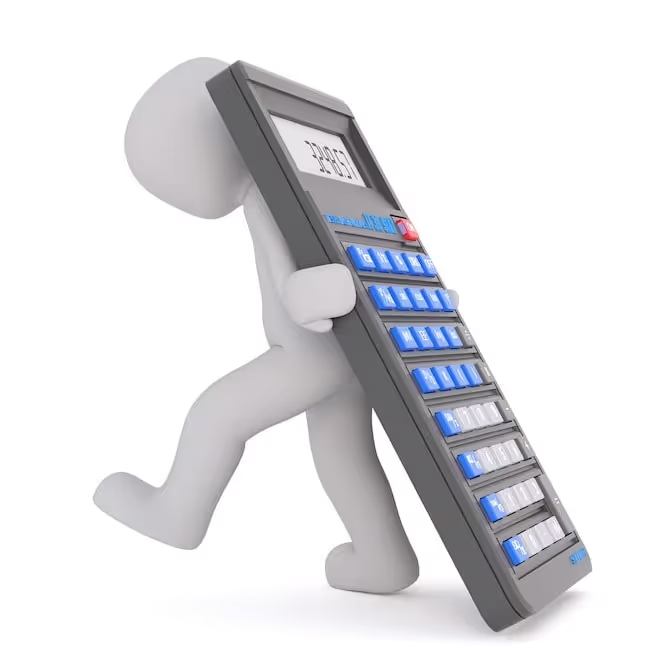
- Keep a calculator handy for arithmetic. One of the most recommended accommodations for adults with dyscalculia is using a calculator to do addition, subtraction, multiplication and division. You can either use a hand-held one or make use of the calculator function on your phone, tablet or computer. In certain exams you might need an official letter certifying your dyscalculia in order to gain access to this accommodation. If you struggle with numbers during your day to day, don’t be embarrassed to reach for the calculator as many times as is necessary.
- Use multi-sensory approaches to learn and practice math facts. Math facts are equations, including simple sums and times tables that mostly involve single digit numbers. For example, 2+1=3 and 4x2=8 are math facts. It’s useful to commit them to memory so they become automatized, meaning you can skip the calculation step and solve some problems without pen and paper. Because individuals with dyscalculia and dyslexia may struggle to learn math facts, it’s recommended you try multi-sensory approaches, such as writing them out while saying them aloud.
- Download banking and money apps to help with management of finances. Management of personal finances can often be both a source of stress and financial penalties. If you’re struggling with money management, there are a number of free apps that can help. For the less technologically gifted, your local council or town hall should be able to point you in the direction of community counseling and advice on money management. Don’t be afraid to reach out to friends and family for help! Sometimes just getting all of your incoming and outgoing expenses down on paper and taking time to process the numbers can make a big difference in relieving the stress and anxiety associated with money matters.
- Get excited about math. Positive thoughts and emotions can go a long way in helping combat math anxiety. They can also give you the energy and motivation you need to pursue further education and improve your skills. You may want to try repeating personal mantras such as “I can do math. Math is fun. I will learn one step at a time.” Alternatively, sign up for a free trial of TTRS and give our ‘"Motivational Math" typing module a try!
Spelling and Math help from TTRS
Touch-type Read and Spell is a widely used typing and literacy tool in education programs for adults. It helps mature learners master typing on the keyboard and improve their spelling and reading skills at the same time. This happens thanks to a multi-sensory approach in which words and numbers are read aloud, shown on the screen and then typed out on the keyboard. Learning is incremental, and the design is simple and effective, to keep you focused and on task. This is great for adults who also struggle with attention difficulties.
TTRS is additionally useful for learners with dyscalculia because it’s a fun and multi-sensory way to learn and practice math facts. When dyslexia is present, the course provides added benefit, including a structured approach to strengthening phonics skills.
Top Tip: Try a math facts typing module from TTRS. You will see the math fact written on the screen, hear it read aloud and type it out on the line below. This is a multi-sensory way of learning. For the maximum benefit, repeat the audio aloud as you type. You can take modules as many times as is necessary until you feel you have learned the material.
Share your story with us
Do you suspect you are struggling with a math-based learning difficulty? What do you do in your day to day that helps you work with numbers? Which situations do you avoid because of your dyscalculia? Let us know if you’ve decided to go back to school to improve your skills. We welcome personal anecdotes and look forward to hearing from you!
References
- Shavel, R.S., Manor, O., Karem, B., Ayali, M., Badichi, N., Friedlander, Y., & Gross-Tsur, V. (2001). Developmental dyscalculia is a familial learning disability. Journal of Learning Disabilities, 34(1), 59-65.
- Ashcraft (2002). Math anxiety: Personal, educational, and cognitive consequences. Current Directions in Psychological Science, 11(5) 181-185.
- Soares, N. & Patel, D.R. (2015). Dyscalculia. International Journal of Child and Adolescent Health, 8(1), 15–26.
- Traff, U. & Passolunghi, M.C. (2015). Mathematical skills in children with dyslexia. Learning and Individual Differences, 40, 108-114.