

Teaching phonemic awareness

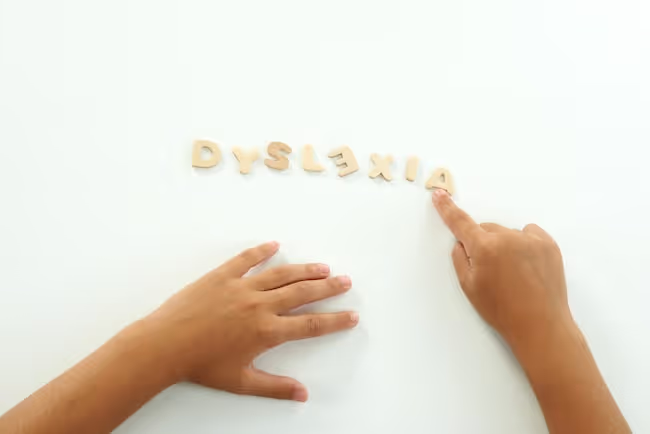
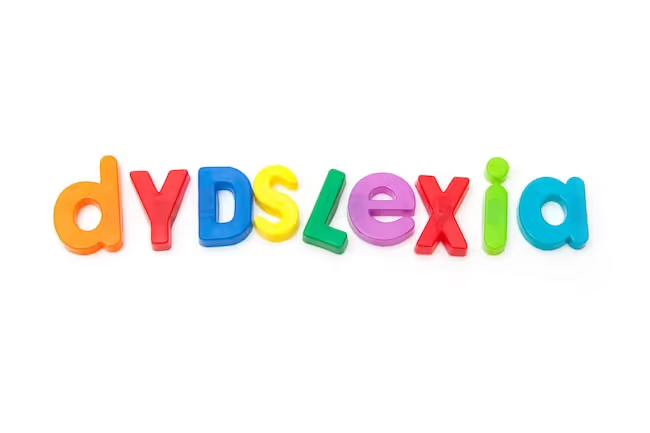
Teaching phonemic awareness helps children develop into strong readers and is especially important for learners with dyslexia.

Teaching phonemic awareness

Teaching phonemic awareness helps children develop into strong readers and is especially important for learners with dyslexia.

teaching phonemic awareness

One of the key skills children must develop before they learn how to read is phonemic awareness— being able to hear and manipulate the sounds that make up words.

Phonemes are the smallest units of sounds that can change meaning -- if you switch the middle vowel sound in hat, everything shifts from definition to part of speech and usage.

A child with phonemic awareness knows that sat is made up of three distinct sounds. They may also realize that sat and bat end in a similar sound and that hat and heart start with the same sound.

It is the recognition that language is made up of these sounds that is so important in reading.

Developing language and sounds

Just as written language is composed of letters of the alphabet, phonemes are the building blocks of oral language.

A child begins learning the phonemes of his or her mother tongue from birth. In fact, babies are born with the ability to hear all of the sounds that make up the 6,000+ spoken world languages.

However, by the time they are 1-year-old monolingual children have tuned their ears to the sounds around them.

Babbling prepares them for speaking; they practice making sounds until they are ready to string them together into words and coherent utterances. As their vocabulary grows, kids begin to develop phonological awareness – of which phonemic awareness is a part, at home.

Nursery school and kindergarten help them hone their skills, including the ability to rhyme, count syllables and segment words into beginning, middle and end sounds.

Phonemic awareness comes about gradually through exposure to nonsense words, rhymes and language play

Phonemic awareness

Children acquire phonemic awareness through learning nursery rhymes, singing songs that contain phoneme strings like E-I-E-I-O in “Old McDonald Had a Farm” and being read stories that use alliteration or nonsense words for proper nouns.

Dr. Seuss books are a great example of books that play with phonemes by substituting sounds in and out in order to create long strings of similar sounding language such as  “HE, ME, He is after me. HIM, JIM, Jim is after him," from Hop on Pop.

Clapping hands and banging on drums supports counting the syllables in words and tasks such as providing a starter word and having kids come up with words that rhyme are commonly used to test for phonological awareness.

TIP: Did you know Dr. Seuss books also commonly contain vocabulary from the Dolch List? The Dolch List is a set of high frequency terms that are found in printed material for children. Building familiarity with these words can help children recognize them by sight, which reduces the cognitive load for beginner readers. Learn more in teaching Sight Words.

Understanding how spoken language works helps children prepare for learning the alphabet and developing strong phonics skills, so they can map sounds to letters in order to decode words in reading. It also supports early spelling skills.

It’s not surprising then that researchers have identified phonemic awareness as the single most important factor in the success of a child who is learning how to read. It also explains why some individuals, including children with dyslexia, struggle when it comes to reading.

Additional pre-literacy skills

In addition to manipulating phonemes, there are six pre-literacy skills that can support early reading efforts in children. It’s important to foster a love of reading and familiarity with how books work.

Parents can do this by reading to children from the day they are born – learn more about motivating kids to read. It’s also crucial to help children expand their oral vocabulary, as it is easier to read a word you already know. Ensuring a child is exposed to examples of print, teaching them the alphabet, and practicing narrative through sequential storytelling also prepares children for reading.

Learning to read

Reading instruction starts by teaching kids to sound out one word at a time. Repeat exposure to this word will eventually help the child recognize it by sight. The more vocabulary children recognize, the less cognitively demanding reading becomes, as they only need to decode unfamiliar terms.

Children acquire most of their vocabulary through reading when they take a guess at the meaning of an unknown word using contextual clues. As their vocabulary grows and they recognize more words, they become faster and more adept at understanding meaning, including the gist, main ideas and specific details of a text.

Learn more about teaching children to read.
Teaching students to decode a word requires knowledge of phonics

Dyslexia

More than 70% of individuals with dyslexia struggle to break words down into their component sounds.

When phonemic awareness is complicated by a specific learning difficulty, it is important to reinforce phonics skills through targeted training.

The Touch-type Read and Spell program teaches touch-typing in a dyslexia friendly way by presenting individual letters on the screen, playing the corresponding sound or word aloud, and showing users how to type the correct key(s).

Multi-sensory learning reinforces sound-letter mapping and the course includes Dolch Words to build familiarity with common vocabulary. It’s also possible for kids to repeat modules until they are comfortable with the material covered and ready to move on. This process enhances spelling skills and facilitates sight reading at the same time.

Do you have any tips on teaching phonemic awareness? Join the discussion!

I have a ten year-old son who has dyslexia and a daughter who is in eighth grade - she also uses Touch-type Read and Spell. My son came up to me the other day and said ‘so comb has a silent b.’ He’s noticing it because he’s hearing it, seeing it and typing it, multiple times over - and this is from only 15 minutes a day.

Vivian, Homeschooler of a child with dyslexia

I have a ten year-old son who has dyslexia and a daughter who is in eighth grade - she also uses Touch-type Read and Spell. My son came up to me the other day and said ‘so comb has a silent b.’ He’s noticing it because he’s hearing it, seeing it and typing it, multiple times over - and this is from only 15 minutes a day.

Vivian, Homeschooler of a child with dyslexia

Find the solution that’s right for you

Explore our tailored subscriptions and find the perfect fit

Families

For individuals and families, suitable for kids and adults

Schools and tutors

Touch-typing, reading and spelling support for students

Homeschoolers

Touch-typing as part of a homeschool curriculum

More related articles from Read and Spell:

5 Tips for teaching sight words

A lot of the learning for homeschool these days is online and so my kids needed to know how to type. What I liked most about TTRS is that it caters to different learning styles. We don't have any specific learning difficulties in the family, but it really supported and bolstered my kids as they were learning how to read.

This is some text inside of a div block.

How to build self-confidence in students

So far, TTRS has made a big difference in her literacy and typing skills. But what my daughter and I like best about the program is it doesn't make her feel stupid. We've tried a lot of different tools, and many of them can be quite demoralizing. Not TTRS. In fact, it's the opposite. Learning to type has been a huge confidence booster for her.

This is some text inside of a div block.

6 Early literacy skills

A lot of the learning for homeschool these days is online and so my kids needed to know how to type. What I liked most about TTRS is that it caters to different learning styles. We don't have any specific learning difficulties in the family, but it really supported and bolstered my kids as they were learning how to read.

This is some text inside of a div block.

Teaching students with dyslexia

So far, TTRS has made a big difference in her literacy and typing skills. But what my daughter and I like best about the program is it doesn't make her feel stupid. We've tried a lot of different tools, and many of them can be quite demoralizing. Not TTRS. In fact, it's the opposite. Learning to type has been a huge confidence booster for her.

This is some text inside of a div block.

What’s the difference between dyslexia and dyspraxia?

So far, TTRS has made a big difference in her literacy and typing skills. But what my daughter and I like best about the program is it doesn't make her feel stupid. We've tried a lot of different tools, and many of them can be quite demoralizing. Not TTRS. In fact, it's the opposite. Learning to type has been a huge confidence booster for her.

This is some text inside of a div block.

Spelling strategies for dyslexia

I have a ten year-old son who has dyslexia and a daughter who is in eighth grade - she also uses Touch-type Read and Spell. My son came up to me the other day and said 'so comb has a silent b.' He's noticing it because he's hearing it, seeing it and typing it, multiple times over - and this is from only 15 minutes a day.

This is some text inside of a div block.

How to build a homeschool reading program

I homeschool my children who are in fourth and fifth grade. We got Touch-type Read and Spell for typing, but with the phonics support it's benefited their spelling skills as well. They both do one lesson a day. I've noticed they're more confident and that there's been an improvement in their ability to sound out words too.

This is some text inside of a div block.

What are Dolch words?

I have a ten year-old son who has dyslexia and a daughter who is in eighth grade - she also uses Touch-type Read and Spell. My son came up to me the other day and said 'so comb has a silent b.' He's noticing it because he's hearing it, seeing it and typing it, multiple times over - and this is from only 15 minutes a day.

This is some text inside of a div block.

Dyslexia and spelling - what's the connection?

I have a ten year-old son who has dyslexia and a daughter who is in eighth grade - she also uses Touch-type Read and Spell. My son came up to me the other day and said 'so comb has a silent b.' He's noticing it because he's hearing it, seeing it and typing it, multiple times over - and this is from only 15 minutes a day.

This is some text inside of a div block.

Improve writing skills for kids

We used the Touch-type Read and Spell course to teach my ten-year-old son typing, in order to help him with his writing. He really liked books but was never that keen on the reading bit. He was also quite slow to write by hand. His ideas weren't making it onto the paper and his teachers couldn't always see how intelligent and creative he was. TTRS has helped my son show his strengths!

This is some text inside of a div block.

Our touch-typing coloring book isn't just fun, it hones fine motor skills, teaches touch-typing hand positions and enhances familiarity with the keyboard layout too! Let your child explore and learn in a fun and tactile way.

Thank you! Your submission has been received!