



Visual processing disorders can interrupt an individual’s ability to understand and navigate written symbols, which may cause problems with math and learning to read at school. They’re not due to vision problems or any issues with the eyes, but rather with how the brain interprets visual information.
On the other hand, dyslexia is a separate condition that often makes it challenging to break spoken language down into its component parts. This, in turn, complicates reading and spelling. While the two conditions can look similar, they have different causes and thus children and adults who have one and not the other will require a different set of strategies and accommodations.
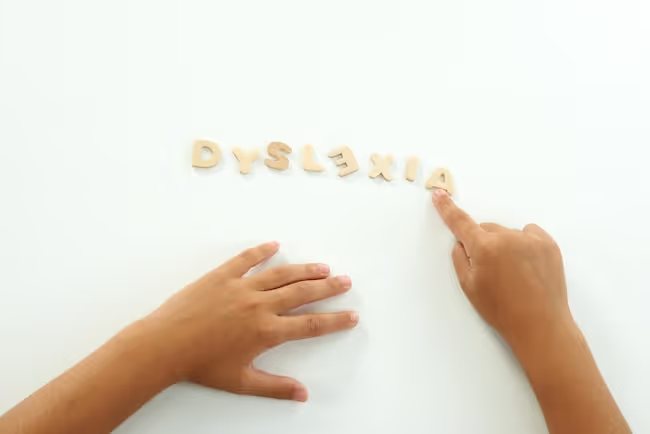
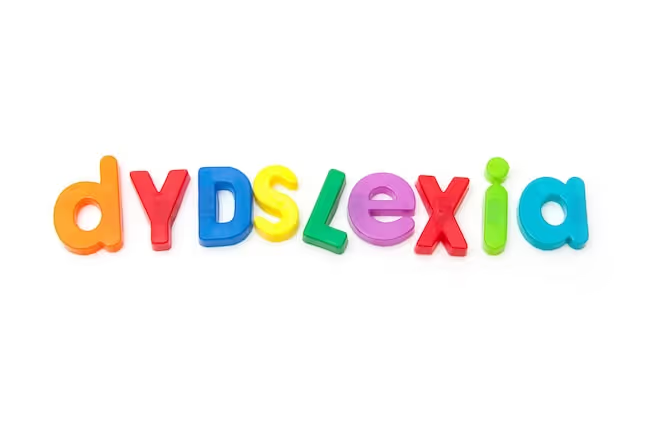
You may also encounter the term visual dyslexia, which can describe individuals who have dyslexia but are prone to reversing or transposing letters, struggle with locating words on the page, and have a tendency to skip words.
Some research suggests that children who struggle with learning difficulties, such as dyslexia, or attention disorders like ADHD, are more likely to experience some form of visual processing disorder (1). When a visual processing disorder and dyslexia co-occur, both auditory and visual processing of language can be problematic. In other words, a child can struggle to access the print and make sense of the language he or she encounters.
This disruption to literacy skills can have severe implications for learning, given the importance of reading and writing at school. It can also cause students to struggle with low self-esteem and low confidence. That’s why it’s important to identify dyslexia and any visual processing difficulties as early as possible, so the right classroom accommodations and strategy training can be put in place. Learn more about identifying dyslexia.
What is dyslexia?
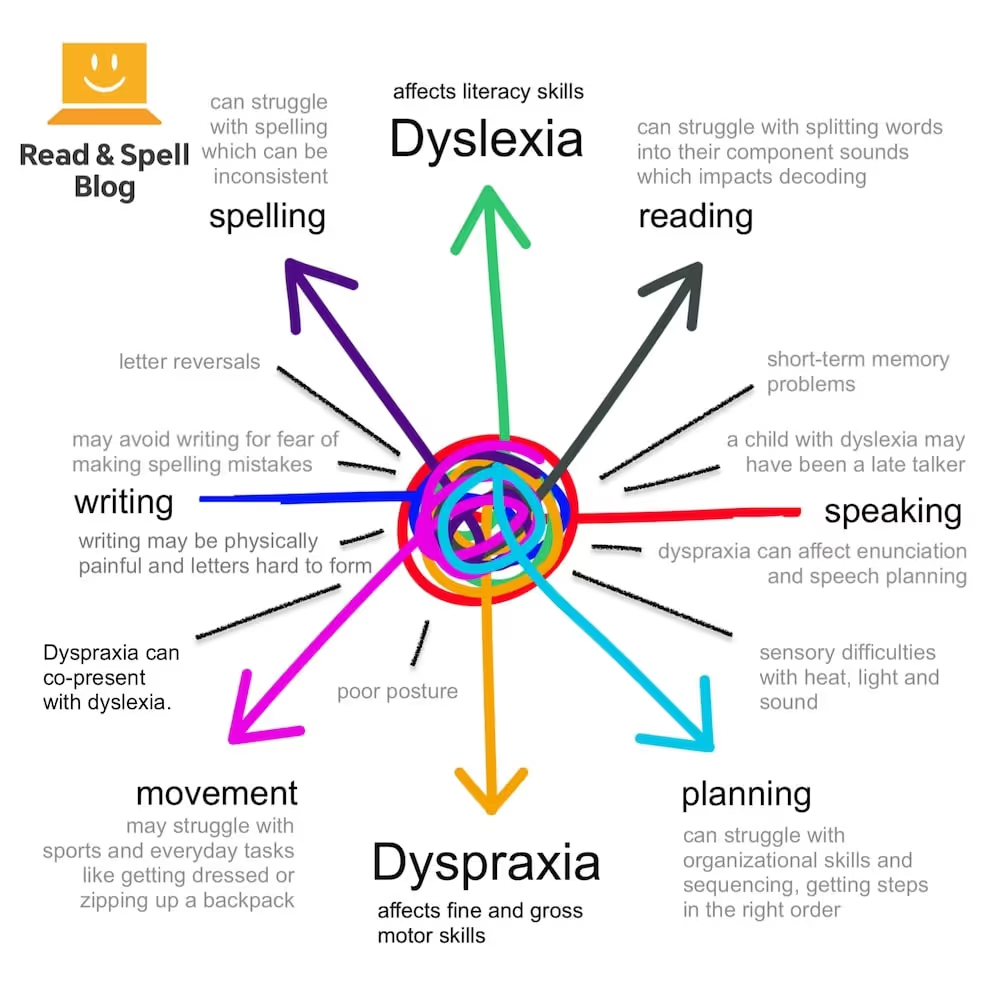
Dyslexia is a specific learning difficulty that can affect a child’s ability to negotiate language. It can affect both written and spoken language – a child with dyslexia may be a late talker and can have early problems with language recall. Nonetheless, a diagnosis is not typically given until a student begins school.
Every case of dyslexia is different; both the severity and symptoms can vary greatly. Some evidence suggests kids with dyslexia have a degree of visual processing impairment (2) and that short-term memory is also implicated.
However, what we know for sure is that dyslexia is not related to intelligence and it’s not uncommon to find a bright and highly motivated child whose reading and writing level is far below that of his or her peers. A child might avoid reading out loud at school and easily become frustrated with text-heavy assignments.
Kids with dyslexia may need additional time to understand prompts and/or produce a response during assessments. In some cases, a child’s written work may be simplified out of fear of making spelling mistakes. Working vocabulary can also be more limited if reading skills are impaired.
Because learning difficulties are often discussed in a negative way, some people are unaware that there are strengths associated with dyslexia. These include keen problem-solving skills, originality, out-of-the-box thinking, and creativity. Certain celebrities and entrepreneurs have even attributed their success to being dyslexic.
Visual processing disorders
Visual processing is characterized by difficulties understanding written symbols, including the symbols used to represent language, numbers, equations and ideas, for example, arrows on a road sign. Individuals who have visual processing disorders are not necessarily visually impaired, nor are they less intelligent than their peers (3).
Their brains simply struggle to make sense of the visual input they receive. They may mix up the orientation or order of symbols, lose their place on a page, and have difficulty reading maps, graphs, charts and other visual organizers.

Visual processing also makes text-based reading a challenge. However, unlike in dyslexia, phonics instruction will not necessarily help a child who is struggling with visual processing. That’s because the problem is not with pairing letters and sounds but rather recognizing the pen strokes that come together to form letters and the letters that make up a word.
For example, visual processing can affect how an individual interprets letter combinations. An ‘rn’ can be misread as an ‘m.’ Similarly, a child might struggle with letters that are built out of the same basic shapes and only distinguished by small marks, such as dots or crosses, as in an l and t. This can be exacerbated in certain fonts which contain serifs and when text is small. Mirror image letters may also be tricky, such as b and d and p and q.
For kids experiencing visual processing difficulties, copying from the board can be a challenge. Text may be blurry which can cause headaches, particularly in different light and when a page contains a lot of "visual noise." It's interesting to note this from the British Dyslexia Association: "Visual stress is not a symptom of dyslexia but 50% of those who have visual stress also happen to be dyslexic." A child may skip words, misread text, skip entire lines, and fail to understand what he or she is reading.
Because reading taxes cognitive resources, kids with visual processing difficulties often tire sooner than their peers and may experience anxiety and frustration when writing by hand. The reason writing is affected is when letters are formed by hand, a degree of spatial reasoning is required to assemble words. A child also needs to reread his or her own text to revise it. This is one reason why it’s often recommended students learn to touch-type on a computer.
Short-term memory that relies on visual learning can additionally be affected. The visuospatial sketchpad is something we use to help us hold visual information in memory long enough so it can be processed. Kids with visual processing difficulties may struggle to play matching card games and other memory activities, as well as to learn a foreign language.
Learn more about visual processing disorders.
6 Tips for teachers
- Keep it simple and reduce visual distraction/noise in handouts. Select handouts and readings carefully and avoid using anything that is too "busy." For example, sheets that contain a lot of notations, formatting, and images, in addition to the target text, are to be avoided. When creating your own materials, try to use a sans-serif font in a larger font size. If you use formatting to bold and underline words inside a document, do so sparingly. Learn more about the best fonts to use when creating resources and materials for kids with learning difficulties.
- Print on colored or textured paper. To make information easier to read, print words in different colors and on different colored paper. Sometimes textured paper can also make a difference. This enhances contrast for learners who struggle to process visual information. For some kids, yellow paper can help, whereas others might benefit more from pink or green.
- Adjust device screens and customize app displays. Most devices and some apps allow for a degree of display customization. For example, Touch-type Read and Spell encourages you to customize the font, background screen colors, text and copytext colors in typing modules. Some learners may prefer darker backgrounds with lighter words to increase visibility. You may also be able to turn on more audio prompts. No two children with visual processing differences are alike, so experiment until you find settings that work best for the individual.
- Provide classroom accommodations when lessons involve copying from the board. Due to issues with short-term memory, copying can be an extremely tedious activity for children with dyslexia and visual processing difficulties. They are more prone to making mistakes, and can find it demotivating and cognitively taxing. Instead, set a child up with a note-taking buddy or create electronic or paper handout versions of lesson content to distribute beforehand.
- Consider audiobook options for longer reading assignments. For some kids, it may be advantageous to find audio options for longer readings. When reading produces stress it can lead to anxiety and make it harder for the child to concentrate. It can also take a learner more time and may result in lower comprehension. Because "reading to learn" is key across most school subjects, audiobooks and computerized text which can be read out with text-to-speech functionality, can make a big difference.
- Teach touch-typing and provide access to computers or tablets. As the physical act of letter-formation in handwriting can be a challenge, students with visual processing difficulties often find pressing a button in typing to be a much faster solution to writing and one that allows them to get their ideas onto the page in a more fluent way. This is especially the case if the child can touch-type, meaning type without looking at the keyboard. In this way, writing becomes a touch-based activity versus something governed by the eyes.
It’s easier to reread electronic text as it can be written in a convenient font, with enhanced contrast, and is amenable to text-to-speech options. An electronic medium also facilitates revision and editing of drafts. For more tips on helping a child who has dyslexia, have a look at this article.
Top Tip: Not every typing program is suitable for a child with visual processing difficulties and/or dyslexia. Touch-type Read and Spell was developed to provide a highly accessible solution for kids with learning difficulties and processing disorders to master typing and enhance literacy skills.
Discover a typing program for students with dyslexia!

Impact on learning to read
When visual processing difficulties are not caught early on, they can cause a child to miss out on developing foundational literacy skills. Learning how to read involves extensive practice with letter recognition and phonics, and plenty of time spent actually reading to develop comprehension skills, sight reading and fluency.
Problems may be less apparent in the early stages of learning to read, in which materials feature mostly isolated words in large print. However, reading ability may be affected in comparison to same-age peers when text is presented at the phrase and sentence level.
While most children read at a faster rate as they progress through elementary school, research into the role of visual processing and visual memory capacity has indicated that processing deficits can cause slower reading speeds (4). As teachers assign more pages for reading homework in later grades, it is easier for a child who struggles with reading to fall behind.
Reading is also linked to exponential growth in vocabulary, which in turn facilitates comprehension. Thus, a child who is still struggling with letter recognition may be severely disadvantaged in terms of vocabulary, which can affect his or her success across all subjects at school.
If dyslexia is also present, challenges can extend to the sequencing of sounds and correct letter sound pairing. Familiar words can be misread and not recognized and a multi-sensory approach to teaching a child to read may need to be adopted. Learn more about multi-sensory reading.
Impact on confidence and self-esteem
The impact of undiagnosed visual processing disorders and dyslexia can be even more severe when it comes to a child’s self-confidence and self-esteem. Learners who find themselves constantly behind their peers may believe there is something wrong with them.
Over time they can develop a negative self-image and feel they are not cut out for learning at school. This is especially tragic given so many of these kids are extremely talented and intellectually gifted young students. That’s why part of helping a child achieve his or her full potential involves finding activities where he or she can be successful.
Tools for learners
Touch-type Read and Spell is a touch-typing program that follows a structured program of phonics, so kids learn to type by practicing with whole words. There’s a central audio component and it’s both a multi-sensory way of strengthening reading skills and developing typing ability.
TTRS is also a great way to build a child’s confidence and motivate them in the classroom. That’s because the lessons are broken down into bite-sized modules to help prevent frustration from over-stimulation and encourage momentum.
There are no distracting visuals and the layout and screen display are highly customizable. Moreover, learners build success gradually, which makes it easier to sustain over time.
Share your story
Do you teach a child who has a visual processing disorder? What experience do you have working with learners who struggle with dyslexia and visual processing difficulties? Please share any tips you have found helpful. We also welcome personal anecdotes from parents concerning reading development in kids with visual processing and language difficulties.
References:
- Koller, H. (2012). Visual processing and learning disorders. Current Opinion in Opthalmology, 23(5), 377-383.
- Slaghuis, W.L., Lovegrove, W.J. & Davidson, J.A. (1993). Visual and language processing deficits are concurrent in dyslexia. Cortex, 29(4). 601-615.
- Janarthanan, S.D. (2017). Visual processing disorder in children. The Opthalmmology Open Journal, 2(2), 45-48.
- Lobier, M., Dubois, M. & Valdois, S. (2013). The role of visual processing speed in reading speed development. PLoS One, 8(4).