


Visual processing disorders occur when the brain has trouble making sense of the visual input it receives. They are distinct from visual impairment in that there is no blindness or issue with the functioning of the eyes. A child may have 20/20 vision and pass a sight test with flying colors but still be unable to distinguish between two objects or make sense of the symbols on a page.
Difficulties can manifest in a number of ways and no two children will face the same challenges. Some may have trouble judging distances, whereas others will struggle with the ability to assess color, size and orientation.
Spatial processing and coordination can be problematic and a child might easily become lost and disorientated or struggle with fine and gross motor skills. While not classed as learning difficulties, visual processing disorders can be mistaken for dyspraxia, dysgraphia, ADHD and dyslexia.
They can also co-present with a specific learning difficulty and have a negative impact on a child’s self-esteem, confidence and performance at school.
Given much of the information students learn in a typical classroom is received through the eyes, visual disorders often affect learning. Students may have trouble focusing and be easily distracted by too much input in their field of vision. They can struggle with physical education, art, music and sports, and reading and writing can also be severely impacted.
Shapes and symbols may be confused because of their orientation or the underlying whole/part relationships. For example, a child may focus only on the individual letters that make up a word or alternatively see only the word itself and not its component parts.
They may find themselves re-reading the same sentence many times or getting lost on the page. However, unlike dyslexia, issues with reading and writing are not related to phonemic awareness deficits.
Visual processing disorders can also affect life skills, such as remembering phone numbers or following directions. For all of these reasons, it’s important to identify visual issues as early as possible and ensure a correct diagnosis is made. With the right strategies and accommodations, every child can realize his or her full potential at school.
Different kinds of visual difficulty
Recognizing and interpreting visual stimuli is a complex function undertaken by the brain and visual processing disorders range greatly in their severity and the aspects of perception they affect. A child may present with one or more of the following:
Spatial difficulty
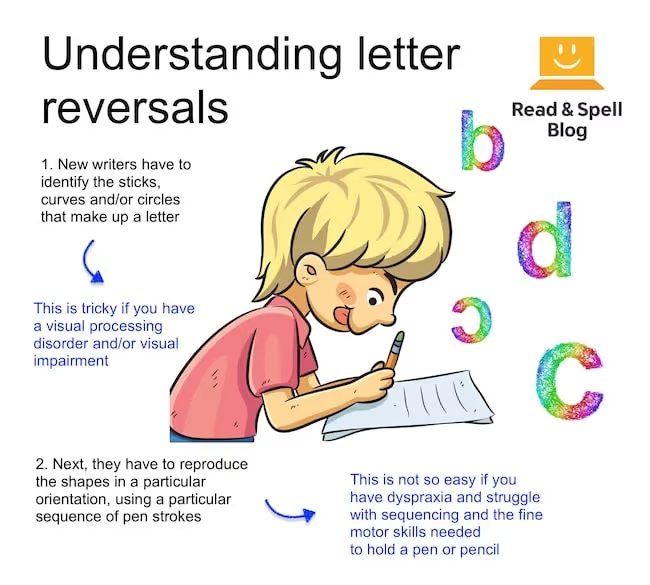
Defined as difficulty processing the location of objects and symbols in relation to each other, symptoms may include directionality issues, such as reversing and confusing letters and numbers with similar shapes. This affects reading skills but can also affect performance in math.
TIP: Did you know lowercase letters may be harder for a child who struggles with dyslexia or dysgraphia to read and write? Learn more about the visual complexity of lowercase vs. capital letters.
Visual discrimination
Being able to identify an object from an image and/or to distinguish between objects of a different color, size, shape and positioning are skills the child may struggle with.
Visual agnosia
A child who struggles with visual discrimination may also have trouble recognizing and naming objects and symbols consistently. This can be problematic in math and reading lessons and is often helped by taking a multi-sensory approach to learning.
Visual closure
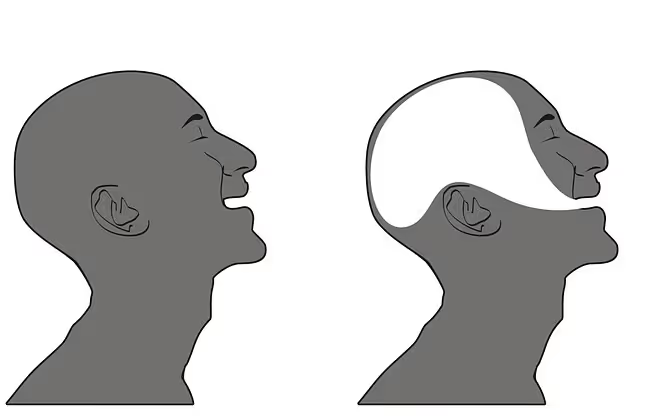
If a child is unable to see 100% of an object the brain typically fills in the missing bits using prior knowledge. However, for children with this type of visual processing difficulty, the object may remain unidentifiable and cause comprehension issues and confusion. Generating a mental image for use in mnemonics can also be difficult.

Visual motor integration
When visual processing disorders affect motor skills it can make it hard for a child to participate in sports because hand eye coordination is often lacking.
Whole/part issues
Discriminating the visual details that signal whole and part relationships may be problematic. For example, fitting together a puzzle can be tricky as the child may not recognize how pieces are related to each other.
Dyslexia, dysgraphia, dyspraxia and ADHD
There are many ways in which the symptoms of visual processing disorders can mimic dyslexia, dysgraphia, dyspraxia and ADHD. Because literacy skills are impacted, reading can be hard and letters may be perceived in reverse position. These are also common issues in dyslexia (although they have a different cause).
A child with spatial and visual motor integration issues may find it hard to write by hand. School assignments can be overly messy and letters and words oddly spaced. This is also a trademark symptom of dysgraphia and is seen in dyspraxia due to the difficulty of holding a writing instrument. The tendency of kids with ADHD to write impulsively can mean they too are prone to submitting messy work.
Children with visual processing disorders may be clumsy and frequently bump into objects in the same way as kids who struggle with dyspraxia do. Watching a video and then switching mediums to complete a worksheet may be hard for them and they can easily become frustrated or tune out, as with cases of ADHD.
Students may miss information presented on bulletin boards. They can also easily lose their place on a page and have a hard time copying text into their notes, as with dysgraphia. They may not see signage and important warnings, which consequently causes them to get in trouble at school.
Like specific learning difficulties, visual processing disorders don’t just cause problems with perception, but rather extend to all areas of a student’s life. They impact on academic and emotional development and left un-diagnosed can contribute to a negative attitude towards school and learning. Children can be embarrassed or become easily frustrated in class. There may also be feelings of low self-worth and a lack of confidence in the classroom.
Learn more about building up a child’s self-esteem, confidence and motivation here, and read about the symptoms of dyspraxia, dysgraphia, ADHD, ADD and dyslexia in these posts.
Classroom accommodations
There are treatments for visual processing difficulties but it’s also important to implement a set of classroom accommodations to prevent children from falling behind. Because no two students will have the same set of symptoms, each approach should be customized for the individual child.
- Repeat information in different modalities. Important information such as task instructions should always be delivered in more than one modality. Teachers might want to say the instructions out loud, demonstrate them and provide a handout. This is good practice in general as it will ensure students with different learning styles and preferences are all given an equal opportunity to prepare for the lesson.
- Provide thickly lined or dotted paper for writing. This can make it easier when writing by hand is required. It’s also helpful for students who struggle with dysgraphia and dyspraxia.
- Set tasks that require multi-sensory feedback. Consider both the modality in which a task is delivered and that in which responses are given and incorporate auditory feedback when possible.
- Make use of tablets and other screens that can be enlarged. Zooming in on an image or piece of text can help reduce visual noise and make it easier for a child to focus during reading.
- Teach them how to touch-type on a computer. Using the muscles in the hand and fingers to type is often an easier way for students to write because they do not need to visually scan the keyboard for keys. It’s also helpful when handwriting is painful or difficult. Learn more about teaching kids to type, including when it is appropriate to start instruction.
- Encourage using an object to guide the eyes during reading. Help guide the eyes with a finger, a ruler or any other object that allows students to keep their place on a page and avoid getting lost during reading.
- Practice reading books with large print. Larger print books may make it easier to process letters, which can have a positive impact on reading comprehension.
- Give students a break. Include some activities that don’t require students to use their eyes. Processing visual input all day can be exhausting so plan lessons that require children to use other senses, such as their ears or sense of touch. Keep in mind that motor skills and hand-eye-coordination can be implicated in physical tasks.
- Set them up with a note-taking buddy. Paying attention to a lesson and writing at the same time can be difficult. Pair students up with a note-taking buddy so they can concentrate on learning instead of struggling to record information. Learn more about helping students take better notes.

Learning to touch-type
The Touch-type Read and Spell approach to touch-typing is different from a traditional keyboarding program as it uses a multi-sensory method combined with a phonics-based curriculum. This means it is dyslexia friendly and will help familiarize students with high frequency English vocabulary to encourage sight-reading. It helps with decoding as well and for students with visual impairments and processing disorders, typing can be a life-saving skill for producing written work.